A lot of people assume the professionals getting the most from AI are the most technical.
Usually, that is not the most important difference.
In many workplaces, the people getting the most value from AI are the ones who understand their own work clearly enough to spot where AI can help, use it with structure, and apply judgment before anything leaves their desk.
That is a very different skill from casually using AI now and then.
It is closer to what OpPro AI calls AI Operator Thinking: understanding how work actually happens, where transformation is taking place, and where AI can create the most leverage.
So what do effective AI operators actually do differently?
They Look for Leverage, Not Novelty
Weak AI use often starts with curiosity.
Someone opens a tool and asks, "What can this do?"
Strong AI use starts somewhere else. It starts with work.
Effective AI operators tend to look at their week and ask:
- Where am I doing repetitive transformation work?
- Where am I losing time to drafting, organizing, summarizing, or structuring?
- Where is the cognitive friction highest?
- Where would a strong first draft or cleaner structure save me real effort?
That is a much better question than "What is the latest AI tool?"
In practice, high-leverage areas often include meeting notes and follow-up, professional emails, prioritization and planning, analysis of feedback or data, and reports and summaries.
This lines up directly with the idea that AI creates the most leverage in the transformation layer of work — not just at the output stage.
They Use AI in a Process, Not as a Shortcut
Another difference is that effective AI operators do not treat AI like a one-click answer machine.
They use it as part of a short process.
One of the most useful structures here is:
- Build: give AI enough context to produce a useful first draft
- Refine: improve the output with one or two targeted adjustments
- Deliver: shape the result into something you can actually use right away
That matters because the first output is often not the best one. Effective operators know the quality jump usually happens during refinement, not just at the first response.
This is one reason two people can use the same AI tool and get very different value from it. The weaker user stops at the first decent answer. The stronger user treats that answer as a draft and makes it better.
They Build Repeatable Workflows
One of the clearest differences between casual AI users and effective AI operators is consistency.
Casual users try AI when they remember it exists.
Effective operators build repeatable systems around recurring work.
That could look like:
- A meeting-to-action system for turning raw notes into decisions and action items
- An executive communication system for high-stakes emails
- An insight-to-report system for turning findings into leadership-ready summaries
In each case, the value is not just speed. It is repeatability.
The same situation comes up. The same workflow runs. The output is consistently better and easier to produce.
They Keep Judgment in the Loop
This is where a lot of otherwise smart AI use breaks down.
A polished output can create false confidence. It looks finished, so people treat it as finished.
Effective AI operators do not do that.
They review the output before using it and ask:
- Is it accurate?
- Does it fit the context?
- Is the tone right?
- Is anything sensitive included?
- Is it actually useful?
That kind of review does not slow strong operators down. It protects the speed they gained by making sure they do not have to backtrack later.
They also know where AI can assist and where it should not lead.
AI can help structure a performance review draft. It should not be the thing deciding whether someone should be promoted. AI can summarize a meeting. It should not own the accountability for a sensitive escalation. AI can help organize thinking. It should not replace consequence-bearing judgment.
They Own the Final Output
This may be the biggest difference of all.
Effective AI operators do not confuse generated language with finished work.
They understand that once the work is sent, shared, or presented, it reflects on them.
That means they cut filler, add specifics, restore voice, verify details, remove anything that does not earn its place, and make the final output feel like something they genuinely stand behind.
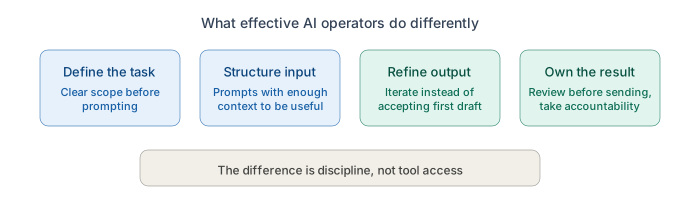
This is why effective AI use is not just about speed. It is about standards.
The professionals getting the most out of AI are not simply the ones who use it the most. They are the ones who use it with the most intention.
They know where AI helps. They know how to structure the interaction. They build systems instead of starting from scratch. And they keep judgment where it belongs: with themselves.
That is what effective AI operators do differently.
If you want to build that skill deliberately, OpPro AI's AI Productivity & Workflow Certification helps working professionals become more effective AI operators through practical workflows, structured prompting, and professional judgment.