A lot of people try AI once, get a weak result, and walk away thinking the tool is overhyped.
Usually, that is the wrong conclusion.
The problem is often not the AI. It is the way the interaction was set up.
When professionals get mediocre output, it is usually because they give too little context, ask for too much at once, stop at the first draft, and never shape the final output for real use.
That is exactly why a practical framework matters.
The Build-Refine-Deliver framework is a simple way to use AI better at work. It is not technical. It is not complicated. And it is much closer to how strong professionals already work with people: give context, improve the draft, then make it usable.
Why Most People Get Weak Results From AI
AI is responsive, not psychic.
It works with what you give it.
When the input is vague, the output is usually vague too. When the request lacks audience, structure, tone, or context, AI fills in the blanks on its own — and the result is often generic, overbroad, or only partly useful.
That leads a lot of people to think they need a better model, a more advanced tool, or a secret prompt trick.
Often, they do not. They need a better process.
What the Build-Refine-Deliver Framework Is
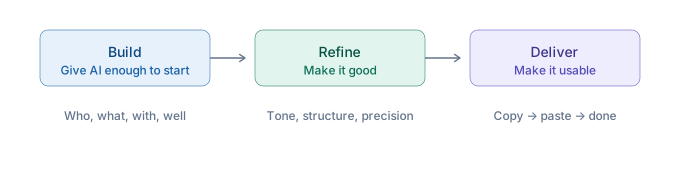
Build-Refine-Deliver is a 3-step method for getting stronger output from AI in real work.
1. Build
This is where you give AI enough to produce a useful first draft.
A simple way to think about Build is with four questions:
- Who is this for?
- What do I need?
- With what input or background?
- Well — what does good look like?
You do not need to answer every question every time. But the more clearly you answer them, the more likely AI is to produce something worth refining.
2. Refine
This is the step most people skip.
They get a response that feels decent enough and move on.
But one or two refinement prompts often make the biggest difference in output quality.
Good refinement usually focuses on tone, structure, precision, clarity, and emphasis.
This is often where a 6 becomes a 9.
3. Deliver
This is the part that makes the output usable.
The goal is not just to get a good answer. The goal is to get the answer in a form you can actually use right away.
That might mean asking AI to format it as an email, turn it into bullet points, make it slide-ready, shape it as a one-page summary, or rewrite it for direct copy-paste use.
Deliver is what removes friction between "AI helped" and "this is ready to use."
How to Use Build-Refine-Deliver in Real Work
The easiest way to understand this framework is to compare weak prompts with stronger ones.
Example 1: Meeting Summary
Basic: Summarize this.
Better: Summarize this meeting into key points.
Great: Summarize this meeting into three sections: decisions made, key discussion points, and action items with owners. Keep it scannable. Use bullet points under each section.
Why the great version works: it defines the structure, clarifies the task, and makes the result immediately useful.
Example 2: Status Update
Basic: Write a status update.
Better: Write a professional weekly status update for my team.
Great: You are a project manager. Write a concise weekly status update for leadership covering progress this week, blockers, and priorities for next week. Tone: direct and confident. Length: under 200 words.
Why the great version works: it gives AI a role, defines the audience, clarifies what to include, and adds tone and length constraints.
Example 3: Difficult Email
Basic: Help me write an email declining this request.
Better: Write a professional email declining this vendor proposal.
Great: Write a professional, respectful email declining this vendor proposal. Acknowledge their effort, give a brief reason without over-explaining, and leave the door open for future work. Keep it under 100 words.
Why the great version works: it defines the emotional goal, gives structure, and keeps the output constrained and realistic.
Why This Works Better Than Chasing the Perfect Prompt
One of the biggest mistakes people make with AI is thinking the whole skill is writing one perfect prompt.
It is not.
The real skill is running a short, focused interaction.
Build gets AI enough context to start well. Refine improves the draft. Deliver makes it useful.
That is a much more practical model for professionals than trying to memorize endless prompt formulas.
It also reflects how good work already happens in the real world: first draft, feedback, better version, final usable output. AI just compresses the cycle.
The Point of the Framework
Build-Refine-Deliver is not a hack. It is a better operating rhythm for using AI at work.
It helps professionals get better first drafts, improve output faster, reduce cleanup time, create more consistent results, and use AI more intentionally.
Most importantly, it turns prompting from guesswork into a repeatable skill.
If you have had mixed experiences with AI, the answer is probably not to give up on it. It is to use it with a better method.
If you want to build that skill more deliberately, OpPro AI's AI Productivity & Workflow Certification teaches Build-Refine-Deliver as part of a broader system for real workplace AI fluency.