
"Good with tech" used to be a useful compliment.
It suggested someone could adapt quickly, learn tools, and navigate modern work without a lot of hand-holding.
But that label is starting to feel too broad for the moment we are in now.
Because using technology well is no longer just about knowing your way around software. Increasingly, it is about knowing how to work with AI in a way that actually improves the quality, speed, and leverage of your work.
That is where a more useful term comes in:
AI operator.
An AI operator is not just someone who uses AI tools. An AI operator is someone who knows where AI can help, how to use it with structure, and how to apply judgment so the output is actually useful in real professional work.
That is a more specific skill than being "interested in AI." It is also a more valuable one.
An AI Operator Is Not Just Someone Who Uses AI
A lot of professionals use AI casually now.
They paste something into a chatbot, ask for a summary, maybe draft an email, maybe clean up some writing, and move on.
That does not automatically make them an AI operator.
Using AI occasionally is not the same thing as operating with AI well.
The difference is intention.
A casual user sees AI as a tool they sometimes try. An AI operator sees AI as part of how work gets done.
That does not mean they use it for everything. It means they know where it fits, where it does not, and how to use it in a way that is repeatable and professionally sound.
What AI Operators Actually See in Their Work
One of the clearest differences between strong AI use and weak AI use is how someone sees their own work.
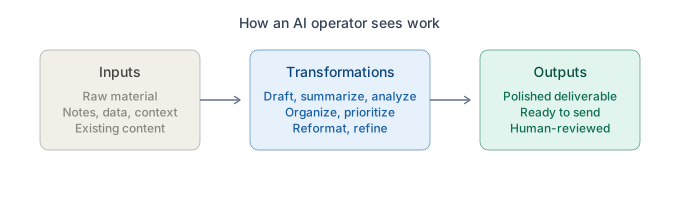
Most jobs, no matter the title, can be broken down into three parts:
- Inputs: the information that comes in
- Transformations: what you do with that information
- Outputs: what you send, present, decide, or produce
Inputs might be meeting notes, data, requests, feedback, Slack messages, or emails. Outputs might be reports, recommendations, follow-ups, plans, decks, or decisions.
But the highest-friction part is usually the middle: the transformation.
That is where you summarize, rewrite, organize, analyze, prioritize, structure, and translate information into something useful.
That is also where AI often creates the most leverage.
An AI operator sees that clearly. Instead of asking, "How do I use AI more?" they tend to ask, "Where in my work am I repeatedly transforming information, and could AI help with that step?"
That shift sounds small, but it changes everything. It moves AI from novelty to leverage.
The Core Skills of an AI Operator
An AI operator is not defined by one tool or one prompt trick. It is a broader workplace capability.
In practice, that usually includes four foundational skills.
1. Knowing Where AI Can Help
Strong operators do not throw AI at everything. They know that AI is often most useful for tasks like drafting, summarizing, reorganizing, prioritizing, extracting patterns, and structuring information.
They also know that some work still needs to stay human-led, especially when the task carries consequence, accountability, or sensitive context.
2. Using AI With Structure
Strong AI use is rarely random. An AI operator knows how to give enough context, shape the task clearly, and improve the output instead of settling for the first response.
They understand that good output is usually the result of a process, not a lucky prompt.
3. Building Repeatable Systems
One of the biggest differences between casual use and operator-level use is repeatability.
Casual users start from scratch over and over. AI operators tend to save what works. They build reusable prompts, lightweight workflows, and repeatable ways of handling common work — whether that is meeting follow-up, communication, prioritization, analysis, or reporting.
4. Applying Judgment Before Using the Output
This may be the most important part.
An AI operator does not confuse generated output with finished work. They know the final step still belongs to them.
That means checking accuracy, context, tone, sensitivity, and usefulness. Once the work goes out, it reflects on the person using it, not the tool that helped generate it.
Why "AI Operator" Is a More Useful Skill Than "Tech-Savvy"
The phrase "tech-savvy" is still useful in a loose sense, but it is increasingly incomplete.
Because being comfortable with software is not the same as knowing how to create leverage with AI.
An AI operator is combining tool awareness, workflow thinking, communication quality, decision support, and professional judgment.
That makes "AI operator" a better description of modern workplace capability. It reflects not just familiarity with technology, but the ability to use AI in a way that improves execution.
This is not about being the person who knows the newest app. It is about being the person who can take messy work, apply the right structure, and get to a better result faster without lowering the standard.
AI Operator Is a Category Worth Paying Attention To
As AI becomes more normal in office work, the real dividing line will probably not be between people who have used AI and people who have not.
It will be between people who use AI casually and people who know how to operate with it well.
That second group will likely have an advantage. Not because AI replaces judgment, but because they know how to combine AI with judgment.
They know when to use it. They know how to shape it. They know how to review it. And they know how to build it into real work instead of treating it like a novelty.
That is what makes "AI operator" such a useful term. It describes a real skill, not just a trend.
If you want to build that skill deliberately, OpPro AI's AI Productivity & Workflow Certification is designed to help working professionals become stronger AI operators through practical workflows, structured prompting, and sound judgment.