
It is a fair question.
There is already a huge amount of free AI content online: YouTube tutorials, blog posts, prompt libraries, LinkedIn carousels, free courses, and endless hot takes.
So if you are considering paying for an AI certification, the obvious question is:
Is it actually worth it?
Sometimes yes. Sometimes no.
The more useful answer is not a blanket recommendation. It is understanding what would make one worth it for you.
When an AI Certification Is Probably Not Worth It
Let's start with the honest answer.
An AI certification may not be worth paying for if you are only casually curious about AI, unlikely to apply it in real work, mainly looking for broad inspiration, already self-learning very effectively from free material, or you do not care about structure, accountability, or a credential.
If all you want is light exposure, there is already enough free material online to get started.
That does not make certifications bad. It just means they solve a different problem.
What Actually Makes an AI Certification Valuable
A good AI certification is not valuable just because it exists.
It becomes valuable when it helps someone build a real, usable skill in a more structured and credible way than they would on their own.
1. Practical Application
The learning should connect to real tasks, not just abstract ideas. Can you use what you learned for emails, meetings, prioritization, analysis, reports, communication, and real workplace output? If not, the value is limited.
2. Structured Progression
One of the hardest parts of self-learning is not access to information. It is sequence.
A useful certification should take someone from understanding the opportunity, to using AI with a method, to building repeatable workflows, to applying judgment professionally.
3. Repeatable Skill-Building
A good certification should help you build habits, not just consume content. That means frameworks you can reuse, workflows you can apply repeatedly, prompts you can adapt to your role, and a clearer sense of when AI should and should not help.
4. Proof of Competency
A credential becomes more useful when it signals that you did more than watch videos. Ideally, it should reflect real learning, practical application, some level of competency, and something polished enough to share professionally.
5. Professional Relevance
A certification is more valuable when it matches the work you actually do. Someone looking for deep machine learning theory may need something very different from someone who wants to use AI more effectively in office work.
Free Content vs Structured Skill-Building
Free content is valuable. It can absolutely help people get started.
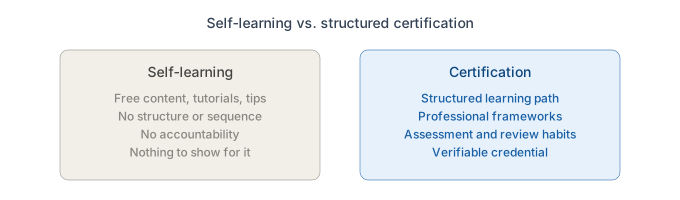
But it also has real limitations: it is fragmented, it often lacks progression, it can be repetitive or shallow, it is easy to consume without applying, and it usually does not create proof of skill.
That is the real tradeoff. Free content gives access. A strong certification gives structure.
For many professionals, the problem is not that they cannot find information. It is that they have too much of it and no clear path for turning it into a practical workplace skill. That is where a good certification can be worth paying for.
Who an AI Certification Makes the Most Sense For
An AI certification is often most useful for professionals who want:
- A faster path to practical skill-building
- Clearer structure than random self-learning
- Repeatable workflows they can use at work
- Better prompting and output review habits
- A stronger way to talk about AI capability professionally
- A polished credential for LinkedIn or a resume
- Proof that they have built real competency, not just interest
For that kind of learner, a good certification can absolutely be worth it. Not because the internet lacks free information. But because structured learning often makes the skill easier to build, apply, and signal.
So, Is an AI Certification Worth It?
It depends on what you need.
If you want casual exploration, free resources may be enough.
If you want practical AI skill-building you can actually use in your work, a good certification may be one of the fastest ways to get there.
The real question is not "Is any AI certification worth it?" It is "Will this certification help me build a skill I will actually use?"
That is the standard that matters.
Not every AI certification is worth paying for. But the right one can be — especially if it helps you build real workplace skill, apply AI more effectively, create repeatable systems, use better judgment, and leave with proof you can share professionally.
That is where a certification becomes more than content. It becomes leverage.
If that is what you are looking for, OpPro AI's AI Productivity & Workflow Certification is designed for working professionals who want practical AI fluency, professional workflows, and a polished, shareable credential.