AI fluency is becoming one of those phrases that people use more and define less.
Some use it to mean knowing how to write prompts. Others use it to mean staying current on AI tools. Some use it even more loosely to describe anyone who has opened ChatGPT a few times and found it helpful.
But in the workplace, AI fluency should mean something more practical than that.
It is not just awareness. It is not just experimentation. And it is definitely not blind reliance on a tool.
AI fluency in the workplace is the ability to use AI effectively, responsibly, and repeatedly to improve how you work.
That means knowing where AI can help, how to use it well, and when your own judgment still needs to lead.
For working professionals, that is the real skill.
AI Fluency Is More Than Knowing How to Open a Tool
A lot of people are still using AI casually.
They paste something into a chatbot, get a decent output, and move on. Sometimes it helps. Sometimes it does not. The process is inconsistent, and the quality depends heavily on luck, guesswork, or how much cleanup they are willing to do afterward.
That is not fluency. That is occasional usage.
Real AI fluency looks different.
A fluent professional understands that AI is most useful when it helps transform information into something usable. In practice, that often means work like:
- Turning meeting notes into a clean summary
- Drafting a professional email from a rough idea
- Organizing a list of priorities
- Extracting patterns from feedback or research
- Structuring a report so the key insight is actually clear
That distinction matters.
The people getting the most value from AI are not always the most technical people in the room. They are often the people who can look at their work clearly, identify where the friction lives, and use AI to improve that step. That is very close to what OpPro AI teaches as AI Operator Thinking: understanding your work in terms of inputs, transformations, and outputs, and using AI where it creates the most leverage — in the transformation step.
What AI Fluency Actually Looks Like at Work
If AI fluency is not just "knowing AI," what does it actually look like in practice?
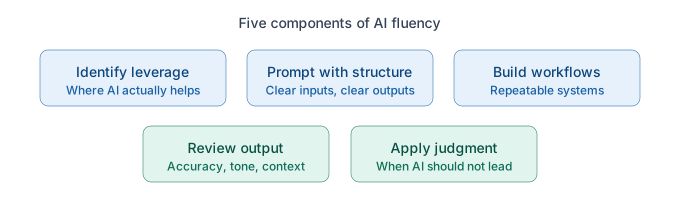
For most professionals, it includes five core capabilities.
1. Knowing Where AI Can Help
AI is not equally useful for every task.
It is often strongest when you are drafting, summarizing, organizing, reformatting, analyzing, or structuring information. It is far less useful when the task depends on judgment, consequence, accountability, or sensitive context.
A fluent professional can tell the difference.
2. Prompting With Enough Structure to Get Useful Output
Good AI use is rarely about writing one magical prompt.
It is more like running a short, focused conversation. One useful model is:
- Build: give enough context for a strong first draft
- Refine: improve the output with one or two targeted adjustments
- Deliver: shape it into something you can actually use
That is a much better mental model than hoping the first response is perfect.
3. Turning One-Off AI Use Into Repeatable Workflows
This is one of the biggest differences between casual users and strong operators.
A casual user experiments when they remember AI exists.
A fluent professional builds repeatable systems for recurring work. For example:
- A meeting-to-action workflow for turning notes into follow-up
- A communication workflow for high-stakes emails
- An insight-to-report workflow for turning raw findings into a leadership-ready summary
The value is not just speed. It is consistency.
4. Reviewing Output Like a Professional
This is where a lot of people go wrong.
They get an output that looks polished enough and forward it too quickly. But professional AI use still requires review.
Before using AI-generated work, a strong operator checks:
- Is it accurate?
- Does it fit the context?
- Is the tone right?
- Is anything sensitive included?
- Is it actually useful?
That review habit is part of AI fluency, not separate from it.
5. Knowing When Human Judgment Still Needs to Lead
AI can help transform information.
It should not replace ownership of a sensitive decision.
For example, AI may help you structure a performance review, summarize notes, or draft communication. But it should not be the thing deciding whether someone gets promoted, whether a conflict gets escalated, or how a high-consequence people decision is made. That is where accountability stays with you.
Why AI Fluency Is Becoming a Real Professional Skill
A few years ago, AI could still be treated like an optional curiosity for many office workers.
That is becoming less true.
As AI tools become more accessible, the gap will grow between professionals who use AI occasionally and professionals who use AI well.
That second group will likely have an advantage because they can:
- Move faster without sacrificing quality
- Reduce blank-page time
- Build leverage into recurring work
- Communicate more clearly
- Spend less energy on low-value friction
- Focus more attention on higher-order thinking
That does not mean AI replaces good judgment. It means professionals who know how to work with AI responsibly will often be better positioned than those who ignore it or use it carelessly.
In that sense, AI fluency is starting to look like other workplace literacy shifts that came before it. Not every professional needed to become a spreadsheet expert, but over time it became valuable to understand how spreadsheets fit into work. The same happened with search, presentation tools, and digital collaboration platforms.
AI is following a similar path. The exact tools may change, but the underlying skill of using AI effectively at work is likely to matter more over time, not less.
How to Start Building AI Fluency
You do not need to become an AI expert to become AI fluent.
A much better starting point is this:
1. Identify a Few Recurring Tasks
Look for work that is repetitive, mentally draining, writing-heavy, summary-heavy, organization-heavy, or analysis-heavy. Those are often the best starting points.
2. Start With Low-Risk, High-Frequency Work
Try AI on tasks like meeting summaries, internal emails, prioritization help, draft outlines, and report structuring. That gives you fast feedback without putting too much at risk.
3. Build a Few Repeatable Prompts or Workflows
Do not start from scratch every time. Save the prompts and steps that work. Over time, the goal is not just "I used AI." The goal is "I have a reliable way to handle this kind of work now."
4. Build a Fast Review Habit
Never confuse polished output with finished output. Review for accuracy, context, tone, sensitivity, and usefulness. That habit protects your credibility while preserving the speed benefit.
The Real Point of AI Fluency
AI fluency is not about sounding impressive. It is about becoming more effective in the real world of work.
It means you know where AI fits, where it does not, and how to use it in a way that improves your speed, quality, and leverage without lowering your standards.
That is a much more useful definition than "being into AI." And for working professionals, it is the one that matters.
The professionals who benefit most from AI will not just be the ones who try the newest tools. They will be the ones who learn how to use AI as part of a professional operating system: clear input, structured prompting, repeatable workflows, and sound judgment.
That is what real AI fluency looks like at work.
If that is a skill you want to build more intentionally, OpPro AI's AI Productivity & Workflow Certification is designed to help working professionals become effective AI operators through practical workflows, professional judgment, and a polished, shareable credential.