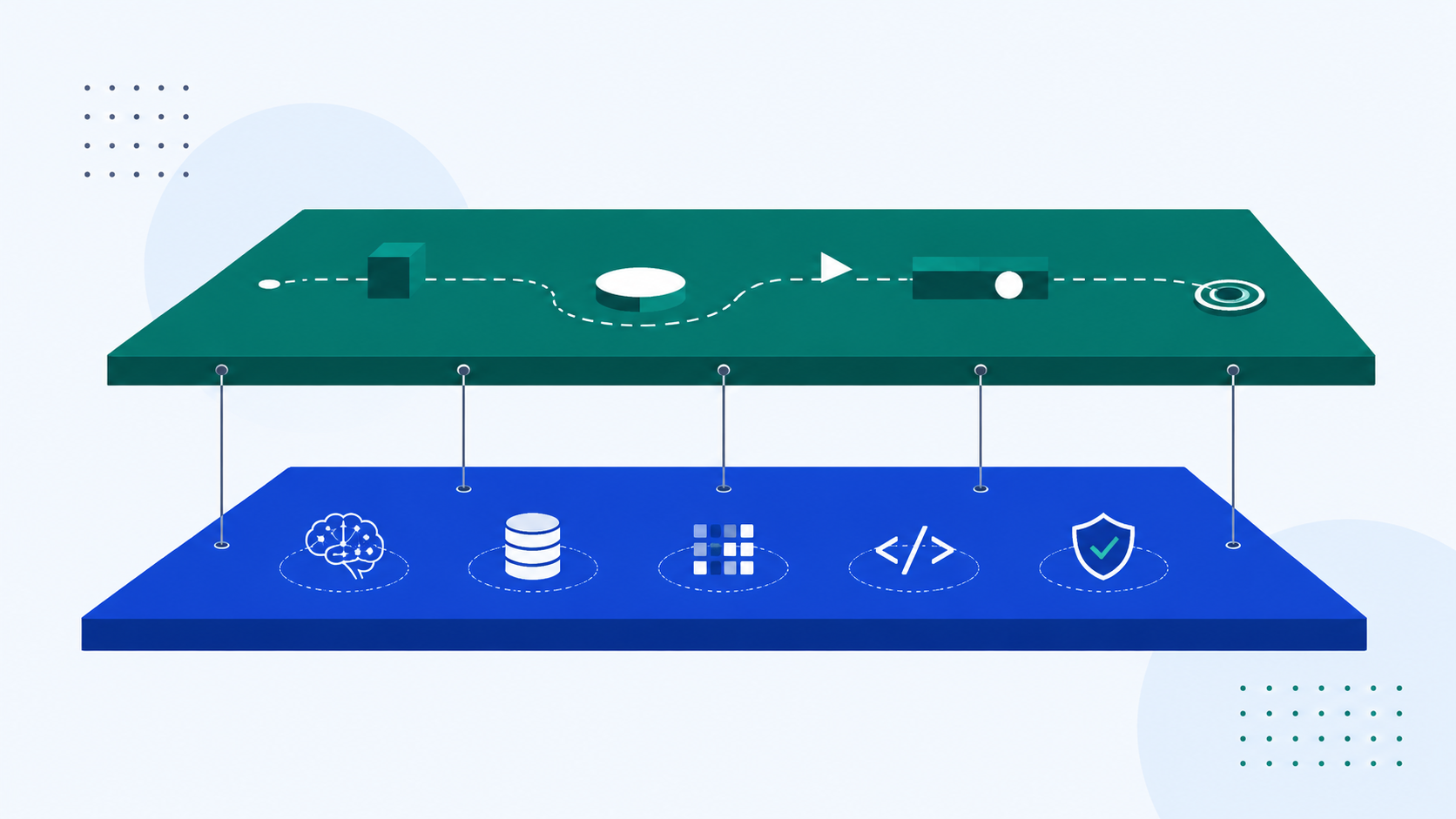
If you work in a corporate environment right now, you have probably heard the word "agents" more in the last six months than in the previous five years combined.
It is showing up in leadership meetings, vendor pitches, LinkedIn posts, and internal strategy decks. Microsoft, IBM, and nearly every major technology company are building their product roadmaps around it. Enterprise research reports are framing it as the next major shift in how organizations operate.
And if you are a working professional trying to figure out what it actually means for your day-to-day work, most of what you are reading probably is not helping. It is either too technical, too vendor-specific, or too speculative to be useful.
This article is a practical overview of agentic AI for professionals who do not build AI systems but do use AI in their work. It covers what agentic AI is, what it could change in corporate settings, and why the foundational skill of being a strong AI operator matters more now, not less.
General LLM Use Is Already a Real Workplace Skill
Before talking about what comes next, it is worth being direct about where things stand right now.
Chat-based AI, the kind most professionals interact with through tools like ChatGPT, Claude, or Copilot, is already a meaningful workplace skill. Using it well is not basic. It is not a novelty. And most professionals still have not developed it intentionally.
The professionals who have built this skill are using AI to draft faster, summarize more effectively, organize their thinking, analyze information, prioritize decisions, and communicate more clearly. They are not replacing their judgment with AI output. They are using AI as a structured part of how they work, refining what it produces, and applying their own standards before anything goes out.
That is what we call AI fluency, and it is the foundation everything else builds on.
If you are already doing this well, you are ahead of most of the workforce. That advantage does not disappear because a newer wave of AI is arriving. It actually becomes more important, because the next layer of AI capability depends on the same skills that make general AI use effective: clarity, structure, workflow thinking, and judgment.
What Agentic AI Actually Is
Most of the AI that professionals use today is interactive. You give it a prompt, it gives you a response. You refine, it adjusts. The human stays in the loop at every step, directing the work as it happens.
Agentic AI works differently. Instead of responding to a single prompt and waiting for the next instruction, an agentic system can pursue a goal across multiple steps. It can break a task into subtasks, decide which tools to use, take actions across different systems, and work through a sequence of decisions to reach an outcome.
Think of it this way: if a chatbot is like a capable assistant you direct one request at a time, an AI agent is more like handing someone a brief and saying, "Go figure this out and come back with the result."
IBM describes agentic AI as systems that can accomplish specific goals with limited supervision, designing their own workflows with available tools. Microsoft's latest research frames the shift as a move toward organizations where AI handles more of the execution while human agency, the ability to direct, decide, and take ownership, expands.
The key distinction is not intelligence. The chatbot and the agent may use the same underlying model. The difference is autonomy: how much of the task execution the system handles on its own before coming back to the human.
This is not science fiction. These systems exist now and are already being deployed in enterprise environments. But for most working professionals, the impact will be gradual and practical, not overnight and dramatic.
What Agentic AI Could Change in Corporate Work
The easiest way to understand where agentic AI fits is to look at the work most professionals quietly dislike: the repetitive, multi-step, coordination-heavy tasks that consume hours but create relatively little value.
Here are some practical examples of where agentic AI could change how corporate work gets done:
Meeting follow-up chains. Instead of someone manually summarizing a meeting, pulling out action items, drafting follow-up emails, updating a project tracker, and pinging three people, an agent could handle that chain end to end, pulling from the meeting transcript, routing the right information to the right places, and flagging anything that needs human review.
Research and synthesis workflows. Instead of spending two hours reading six documents, pulling out key findings, cross-referencing them, and drafting a summary, an agent could handle the gathering, extraction, and first-pass synthesis, giving the professional a structured starting point to review and build on.
Repetitive coordination work. A lot of corporate energy goes into the work between the work: scheduling, status updates, reminders, handoffs between teams, formatting reports for different audiences. Agents could absorb much of this, freeing professionals to spend their time on the decisions and relationships that actually require them.
Task routing and execution. When a customer request, internal ticket, or approval comes in, agents could classify it, pull the relevant context, route it to the right person or system, and pre-populate the information needed to act on it.
Cross-tool operational support. Most corporate workers operate across five to ten tools every day. Agents that can work across those systems, pulling data from one, triggering an action in another, and updating a third, could reduce the manual glue work that currently fills a surprising portion of the workday.
None of these examples require the AI to replace professional judgment. They require it to handle execution steps that currently eat time without creating proportional value. The professional still defines what needs to happen, reviews what the agent produces, and makes the final call.
Why AI Operator Skills Still Matter
This is the part that matters most for anyone building their professional AI capability right now.
As AI systems become more capable and more autonomous, the instinct is to assume that human skills matter less. If the agent can execute multi-step workflows on its own, why does it matter whether the human can prompt well, think in workflows, or review output carefully?
It matters because the stakes go up, not down.
When you are working with a chatbot and you give it a vague prompt, the worst that happens is you get a mediocre draft and spend a few extra minutes refining it. When you give an agent a vague task definition and it executes a multi-step workflow across three systems based on that vagueness, the downstream consequences are real: incorrect data gets routed, the wrong people get notified, or a process runs to completion based on assumptions no one validated.
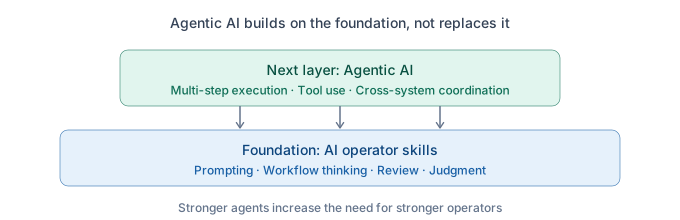
More capable AI does not reduce the need for strong AI operators. It raises the cost of being a weak one.
Here is what agents still need from humans:
Someone to define success. An agent can execute steps, but it cannot decide what the right outcome looks like for your specific situation. That requires business context, stakeholder awareness, and judgment that lives with the human.
Someone to specify the task well. The Build-Refine-Deliver discipline that makes chatbot prompting effective becomes even more critical when you are briefing a system that will go execute multiple steps without checking in at each one. Clarity in specification is not optional. It is the control layer.
Someone to understand the workflow. You cannot delegate a workflow you do not understand. If you do not know what a good meeting follow-up chain looks like, you cannot evaluate whether the agent did it well. Workflow thinking is a prerequisite for effective delegation, whether you are delegating to a person or a system.
Someone to review outputs. Reviewing AI output before it goes out is already a core professional skill. With agents, the review surface expands. You are not just checking a draft. You are checking whether a sequence of actions was executed correctly, whether the right information reached the right places, and whether any step introduced an error that cascaded downstream.
Someone to decide when automation should not lead. Not every task should be handed to an agent, even if it technically could be. Judgment about when human involvement is essential, when the situation is too ambiguous, too sensitive, or too novel for automated execution, is one of the most valuable skills a professional can develop.
The professionals who understand this will thrive as agentic systems expand. The ones who treat agents as magic shortcuts that remove the need for skill, structure, and review will generate exactly the kind of problems that make organizations nervous about AI in the first place.
What Professionals Should Do Now
If you are reading this and wondering what to actually do with this information, here is the practical takeaway.
Get strong at general AI use first. Build your AI fluency. Learn to prompt with structure, refine what AI produces, and build repeatable workflows around the tasks you do regularly. This is the foundation, and it is not going away.
Develop your workflow thinking. Start looking at your recurring work not as individual tasks but as sequences of steps. What triggers the work? What information does it need? What tools are involved? Where does the output go? Understanding your workflows at this level is exactly what makes you capable of directing an agent later.
Build your judgment before you delegate more execution. The professionals who will get the most out of agentic AI are the ones who already know what good output looks like, because they have been producing and reviewing it themselves. Delegation without judgment is not efficiency. It is risk.
Treat agentic AI as an advanced layer, not a shortcut around fundamentals. The relationship between general AI use and agentic AI is the same as the relationship between understanding accounting and using financial automation. The tool amplifies capability. It does not replace the need to understand what you are doing.
The professionals who invest in these foundational skills now will be the ones best positioned to work with more advanced AI systems as they become part of everyday corporate operations.
Looking Ahead
Agentic AI is a real and meaningful evolution in how AI can be applied at work. It is not hype, but it is also not a reason to skip the fundamentals.
The most valuable professionals in an AI-augmented workplace will not be the ones who adopt every new tool fastest. They will be the ones who understand how to define work clearly, direct AI systems effectively, review what gets produced, and apply judgment at every level of complexity.
That is what it means to be an AI operator. And the rise of agentic AI makes that skill more important, not less.
As the landscape continues to evolve, so will the skills worth building. At OpPro AI, that is exactly what we focus on.
If you want to build a strong foundation in professional AI use, our AI Productivity and Workflow Certification is designed to help you get there.