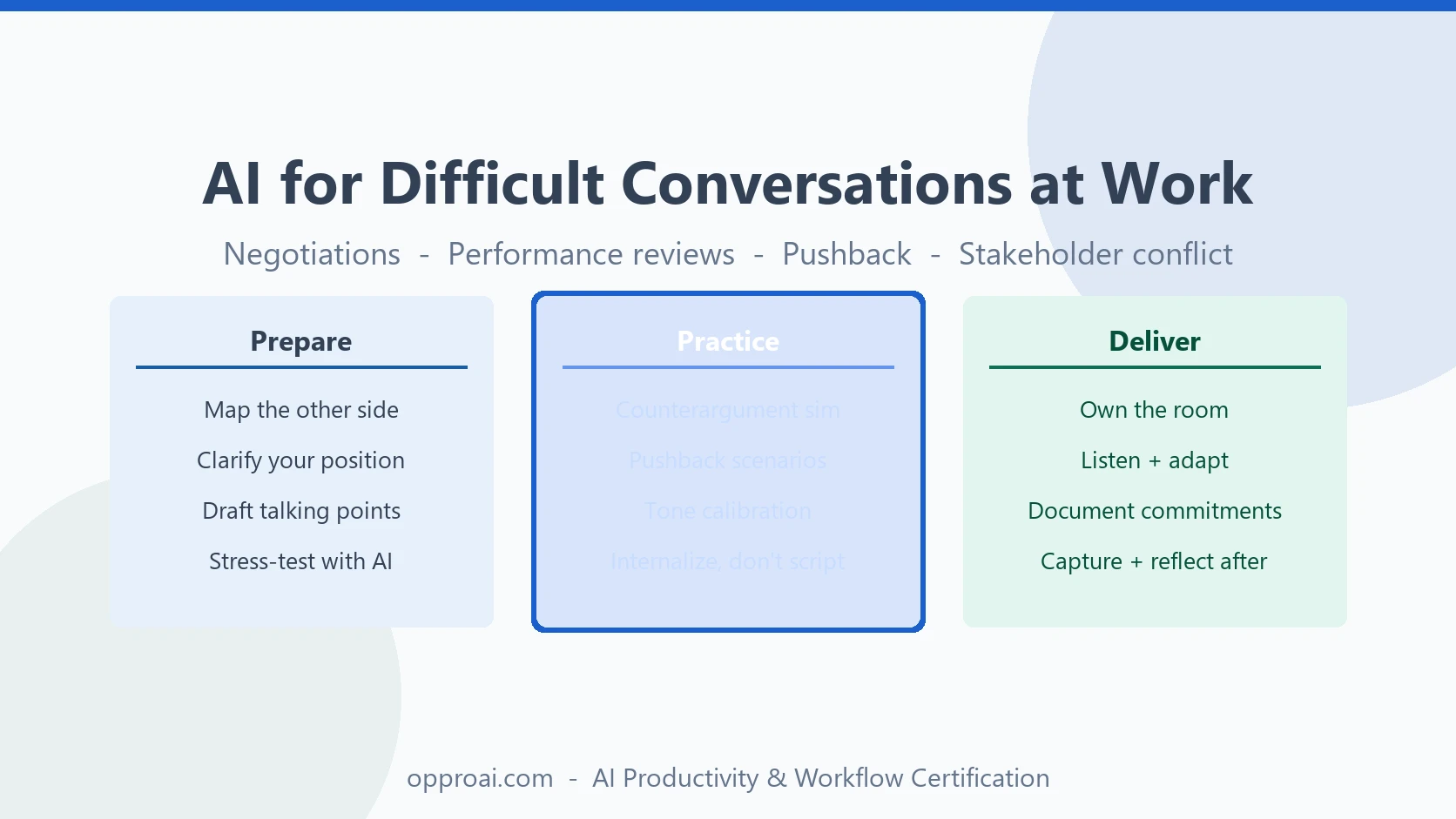
The conversations that matter most at work are usually the ones people prepare for the least.
A salary negotiation. A performance conversation with a direct report who is not meeting expectations. A pushback discussion with a senior stakeholder who is asking for scope that cannot be delivered. A peer confrontation where the working relationship has deteriorated and something needs to be named directly.
These conversations are hard because they involve real stakes, emotional complexity, and uncertainty about how the other side will respond. Most professionals prepare by thinking about what they want to say — and not much else.
That is usually not enough preparation. And it is the exact kind of preparation AI can meaningfully improve.
AI will not have the conversation for you. It cannot read the room, respond to body language, or navigate the real-time dynamics of a high-stakes exchange. What it can do is help you think through every angle before you walk in — so that when the conversation actually happens, you are genuinely prepared rather than just feeling like you are.
Why Preparation Is Where AI Belongs in Difficult Conversations
The line between what AI can and cannot do in high-stakes professional conversations is worth drawing clearly up front.
AI can help with:
- Mapping the other side's likely perspective, concerns, and objections
- Drafting talking points that are clear, direct, and appropriate in tone
- Stress-testing your position by generating counterarguments
- Structuring the conversation logically so it moves toward the outcome you need
- Identifying what you might be missing or underweighting
AI cannot:
- Tell you whether the conversation is the right move at this moment
- Account for the relationship history, organizational politics, or emotional dynamics between you and the other person
- Replace the judgment that comes from knowing your specific situation
- Control how the other person responds in the moment
This division is actually quite useful. Most of the preparation work — the structured thinking, the counterargument mapping, the talking point drafting — is exactly where AI adds value. The in-room judgment stays with you.
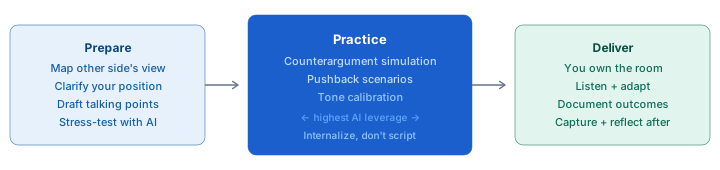
The Preparation Framework
Strong preparation for a difficult conversation involves three distinct types of thinking:
1. Perspective-taking — What is the other side's view of this situation? What do they want? What are they afraid of? What objections will they raise?
2. Position clarity — What do you actually need from this conversation? What is non-negotiable? What can you give on? What does a good outcome look like for both sides?
3. Structure — How do you open the conversation? How do you sequence the key points? Where might it go off track, and how do you bring it back?
AI is useful for all three.
Using AI for Perspective-Taking
The most common preparation mistake is focusing entirely on your own position and ignoring the other side's logic.
AI is genuinely useful as a perspective-taking tool — not because it knows the specific person, but because it can rapidly generate a plausible, structured version of the other side's reasoning.
Prompt example:
I'm preparing for a conversation with a senior stakeholder who has been asking for additional features on a project that is already at risk of missing its deadline. From their perspective, what are the likely reasons they keep pushing for more scope? What are they afraid of? What objections will they raise when I push back? And what would a reasonable outcome look like from their side?
The response will not be perfectly accurate — it is modeling a generic version of your stakeholder, not the specific person. But it will surface concerns and framings you may not have considered, which is exactly what it needs to do.
You can then refine it: "Add context: this stakeholder has been burned in the past by late deliveries and the additional features are tied to a commitment they made to their own leadership."
Using AI to Stress-Test Your Position
Once you know what you are going to say, AI can help you find the weaknesses in it before the other person does.
Prompt for stress-testing:
Here is my plan for the conversation: [describe your intended approach and key points]. Play the role of the other person and push back hard on the weakest parts of my position. What arguments will they make? Where am I most exposed? What am I underweighting?
This is one of the most valuable pre-conversation exercises available. The responses will sometimes feel uncomfortably accurate — which means they are working. Strengthening those weak points before the conversation is significantly easier than doing it in real time.
Using AI to Draft Talking Points
Once you have mapped the perspectives and stress-tested your position, AI can help you draft actual talking points.
The most important thing here is specificity. Generic talking points are easy to produce and largely useless. What you need is language that is direct enough to communicate clearly in a high-stakes moment, without being so scripted that it sounds unnatural.
Prompt for a performance conversation:
I'm managing a direct report who has been consistently missing deadlines and the quality of their work has declined over the past quarter. I've had informal check-ins but this is the first formal conversation about performance. I need to: open without putting them on the defensive, be clear about the specific pattern of concern, communicate the standard that needs to be met, and establish what happens next. Draft three to four direct talking points for each of these goals. Tone: direct, caring, professional. Not punitive.
Prompt for a negotiation:
I'm negotiating [salary / scope / resources / timeline] with [counterpart]. My position: [what you want]. Their likely position: [what you expect them to offer]. Constraints on both sides: [list]. Draft talking points for: opening the negotiation, responding if they push back on my primary ask, what I would accept as a good outcome, and how I close the conversation if we reach agreement.
Prompt for a stakeholder pushback conversation:
I need to tell a stakeholder that we cannot deliver [request] by [deadline] without impact to [other commitment]. They will push back. Draft talking points for: stating the constraint clearly without sounding defensive, presenting the tradeoff options, and holding the position if they pressure me to commit to something we can't deliver.
The Over-Scripting Problem
One important caution: AI can help you over-prepare in a way that actually hurts the conversation.
If you enter a difficult conversation with a rigid script, it shows. The other person will feel it. It makes you look defensive and artificial, and it makes the conversation feel like a performance rather than a real exchange.
The goal of the talking points is to internalize the logic and tone — not to read from a teleprompter.
Use AI to get clear on what you are trying to say and why. Then put the notes away before you walk in. Trust that the preparation has done its job.
Specific High-Stakes Scenarios
Salary negotiation:
The most common salary negotiation mistake is anchoring too low because of anxiety about being rejected. AI can help you research and articulate a confident, specific position.
I'm negotiating my salary for [role] at [company type]. Market range for this role in [location] is approximately [range]. My experience and track record: [describe]. What is a strong opening anchor? What are the key points that justify the high end of my range? How do I respond if they come in below my number?
Performance review conversation (downward):
AI is useful for structuring the balance between directness and fairness — one of the hardest calibrations in management.
I'm giving a performance review to a direct report who has met some expectations but is below standard on [specific areas]. I need to be honest about the gaps without being demoralizing. Draft a structure for the conversation that: opens with recognition of what is going well, is direct and specific about the gaps, connects the gaps to clear standards, and ends with a development plan and timeline.
Delivering bad news to a client or executive:
I need to tell [executive/client] that [project/deliverable] will be delayed by [timeframe] due to [cause]. They are going to be frustrated. Draft an approach that: takes responsibility without over-apologizing, explains the cause clearly, presents what we are doing to minimize impact, and proposes the revised plan. Tone: accountable, direct, forward-looking.
After the Conversation: Capture and Reflect
Difficult conversations often generate important commitments, decisions, and shifts in understanding. AI can help you document these immediately after while the detail is fresh.
Post-conversation prompt:
I just finished a difficult conversation about [topic]. Here are my notes on what happened: [rough notes]. Summarize: what was agreed, what remains unresolved, what I committed to, what they committed to, and what follow-up actions I need to take. Then: what should I have said differently?
The last question — what should I have said differently — is genuinely useful. It converts the experience into a learning loop that makes the next difficult conversation better.
A Note on Limits
AI prepares you for the conversation. It does not predict it.
Real conversations with real people have emotional currents, non-verbal signals, unexpected responses, and moments that require in-the-moment judgment that no preparation fully anticipates.
The professionals who handle difficult conversations best have two things: solid preparation and genuine presence in the room. AI helps with the first. The second is a human skill — the capacity to listen, adapt, and respond to what is actually happening rather than what you planned for.
Preparation makes presence possible. You can be in the room instead of in your head, because you already did the thinking before you walked in.
If you want to build the broader AI skill set that makes this kind of professional application reliable, the OpPro AI AI Productivity & Workflow Certification covers systematic AI use across professional communication, documentation, and judgment.