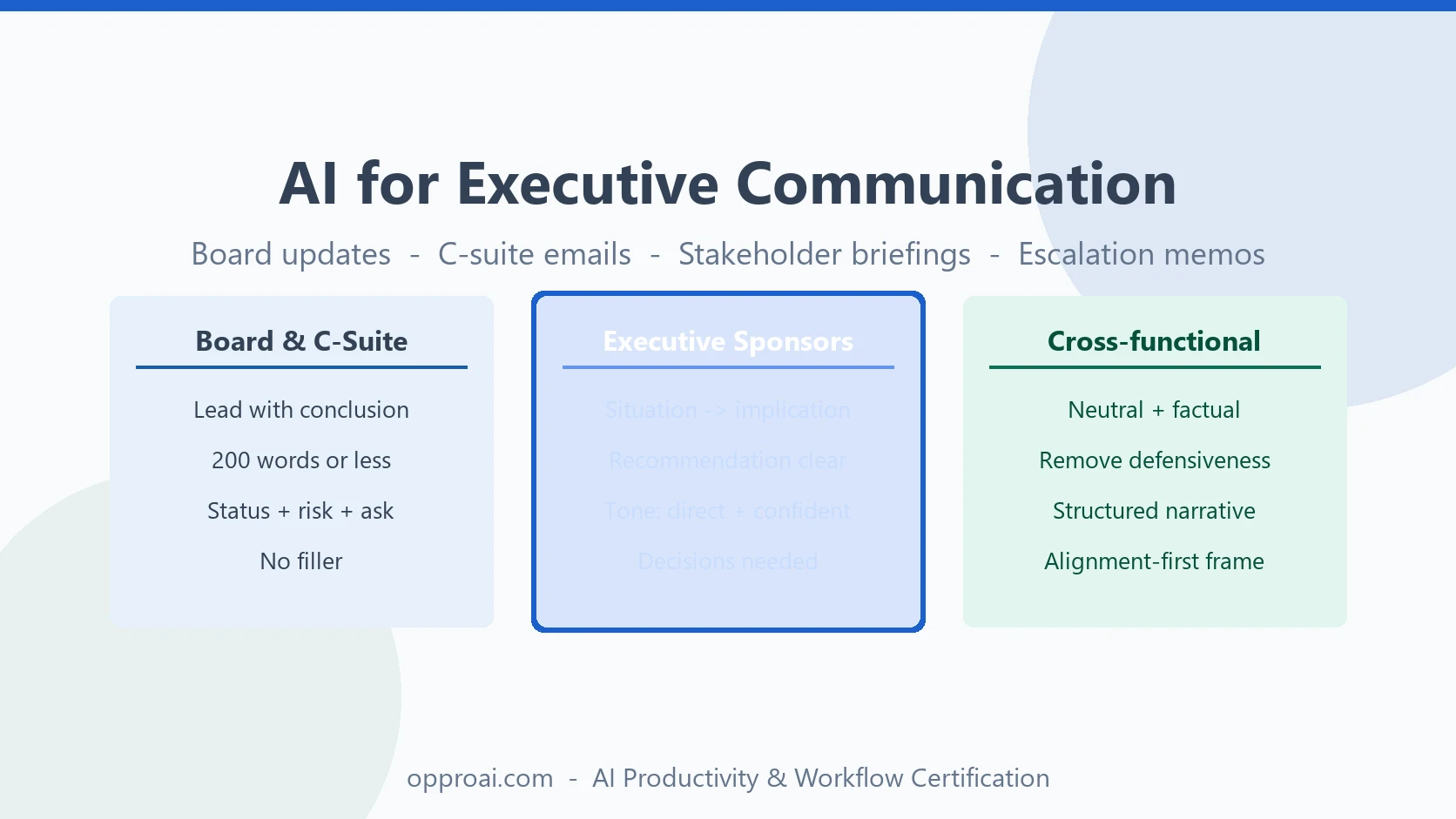
Executive communication is a different game from everyday professional writing.
The stakes are higher. The audience reads faster and tolerates less. A vague email to a direct report is forgettable; a vague email to a board member or a C-suite executive has consequences. The wrong tone in a stakeholder briefing can undermine a relationship that took months to build.
This is precisely why so many senior professionals are cautious about using AI for this type of work — and also why the ones who have figured out the right approach are getting a real advantage.
AI does not replace judgment in high-stakes communication. It accelerates the drafting and structuring process so you can spend your attention where it matters most: on accuracy, tone calibration, and the details only you can get right.
Here's how to use AI effectively for the communication that matters most.
Why Executive Communication Is Different
Most professional communication is functional. It moves information from one person to another. The bar is clarity and completeness.
Executive communication operates differently. At the senior level, how something is communicated often carries as much weight as what is being communicated. The audience reads with pattern recognition developed over years of high-stakes interactions. They notice imprecision. They notice hedging. They notice when the core point is buried.
They also notice when something sounds like it was written by someone who is performing professionalism rather than practicing it.
This creates an interesting challenge for AI-assisted writing. The risk with AI at the executive level is not that the output will be incorrect — it is that it will be generic. It will produce fluent, competent-sounding language that has no specificity, no voice, and no real understanding of the organizational context behind the communication.
The way to solve that problem is not to avoid AI. It is to give AI enough specific context that the output reflects your knowledge of the situation, not just a template.
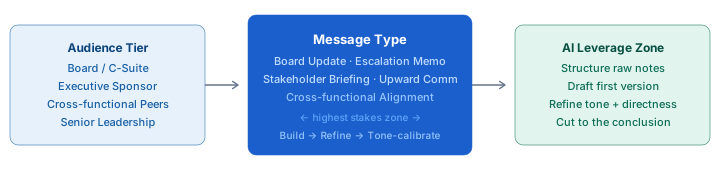
Tier 1: C-Suite and Board Communication
The highest-stakes communications — board updates, CEO briefings, executive committee memos — require the most precision in how you use AI.
The most common mistake here is using AI to write from scratch with a vague prompt. The output will be structurally fine and substantively empty.
The better approach is to use AI to structure and sharpen content you have already gathered.
The workflow that works:
- Write out the raw substance first — in rough notes, bullet points, or a voice memo transcript. What happened, what it means, what you are recommending, what you need.
- Give AI those raw notes along with explicit context: who the audience is, what they already know, what decision you need them to make or what update you need them to receive.
- Ask AI to turn that into a structured first draft with the most important point leading, supporting facts in order of relevance, and no filler.
- Refine for tone. At the executive level, the tone should be direct, confident, and concise. Cut anything that doesn't add information.
Example prompt structure:
I'm writing an update for the board of directors. They meet monthly and already know the background on [project]. Here are my raw notes: [paste notes]. Draft a 200-word executive update. Lead with the current status and key risk. End with what we need from them, if anything. Direct and precise.
That prompt will produce something substantially more useful than "write me an email to the board about this project."
Tier 2: Cross-Functional Stakeholder Communication
Stakeholder communication across departments and functions is where most senior professionals spend the majority of their high-stakes writing time.
This includes: project updates to executive sponsors, escalation memos, inter-department alignment emails, briefings ahead of key decisions, and communications to functions where you do not have a direct reporting relationship.
The challenge here is calibration. Stakeholders at this level are busy, political, and sensitive to tone. They notice when communication is defensive. They notice when the writer is managing perception rather than sharing information.
AI is useful here for two specific things: structure and neutrality.
Structure: AI can reliably turn messy notes into a clean narrative with clear sections. For stakeholder updates, a consistent structure (situation → implications → recommendation or request) helps the reader process information quickly and reduces friction.
Neutrality: When communication is politically charged, AI can help you draft language that is factual and clear without inadvertently signaling defensiveness or blame. You can prompt AI to "remove any language that sounds like blame or deflection" or "rewrite this to be direct about the problem without implying failure of any specific team."
Tier 3: Senior Manager to Leadership Communication
The most common executive communication scenario for most professionals is upward communication to senior leadership: status updates, escalations, recommendations, requests for resources or decisions.
This is where AI creates the most practical, day-to-day leverage — and where a small improvement in communication quality has direct career impact.
The single most valuable habit here is leading with the conclusion.
Most professionals draft these communications in the order they experienced events — background first, details next, conclusion at the end. Leaders at the senior level read in reverse. They want the conclusion immediately, followed by the supporting logic, followed by the details if they need them.
AI can help you restructure any communication for this reading pattern:
Rewrite this update so the conclusion and recommendation appear in the first sentence. Follow with the key supporting points in two or three bullets. Background context last, only if essential.
The Escalation Memo: A Specific Case
Escalation memos are one of the highest-stakes documents a professional writes. The goal is to communicate a problem clearly, establish the stakes, propose a path forward, and do all of that without sounding alarmist, defensive, or like you're assigning blame.
AI handles the structural elements well. Where it needs your input is on the specifics.
A strong escalation memo prompt:
I need to write an escalation memo for [senior executive]. The issue: [describe clearly]. What has been tried: [list]. Current status and risk: [describe]. What I'm recommending: [your recommendation]. Draft a clear escalation memo. Tone should be direct and solutions-oriented. Do not assign blame. Lead with the risk and the ask.
The output will almost always need editing for organizational context and specificity. But it will give you a structurally sound starting point in two minutes instead of thirty.
Tone Calibration: The Step Most People Skip
The biggest source of failure in AI-assisted executive communication is tone.
Generic AI output tends to be formal in a mid-level way — clear, professional, but not appropriately direct for senior communication. It also tends to hedge, which reads as uncertainty in an executive context.
Every AI-assisted executive communication should go through explicit tone refinement before it is used. The best way to do this is with a targeted refinement prompt after the first draft:
- "Make this 25% more direct. Remove hedging phrases."
- "Tighten the opening sentence. It should state the situation immediately."
- "This reads as slightly defensive. Rewrite so the tone is confident and forward-looking."
- "Cut anything that doesn't add information. This should be 30% shorter."
These targeted prompts reliably improve output quality. They take thirty seconds and consistently move the communication from competent to strong.
What AI Cannot Do Here
AI does not know your organization's politics. It does not know the history between you and the person receiving this communication. It does not know which terms or framings carry weight or signal risk in your specific culture.
It cannot tell you whether raising this issue now is the right move. It cannot calibrate for the fact that a specific executive reads things differently than others do. It cannot account for what happened in last week's meeting that changed the context.
These are the things you bring. AI handles the structural and language work. You handle the judgment.
The review step is non-negotiable for executive communication. Before anything goes out, ask: Is this accurate? Is the tone right for this person? Is there anything here that should not be in writing? Is every word earning its place?
Building a Communication System at the Senior Level
The professionals who use AI most effectively for executive communication have done one additional thing: they have built a small library of communication templates for their most common scenarios.
A board update template. A stakeholder escalation template. An upward communication template. A cross-functional alignment email template.
Each template captures the structure and tone standards that work for their specific context. Each one was built from prompts that produced output they actually used.
This library takes about two hours to build and saves significant time every week after that — while also raising the quality floor on all of their high-stakes writing.
If you want to build a systematic approach to AI-assisted professional communication, the OpPro AI AI Productivity & Workflow Certification covers communication workflows alongside prompting, review processes, and the broader skill set that makes AI use consistent and professional.