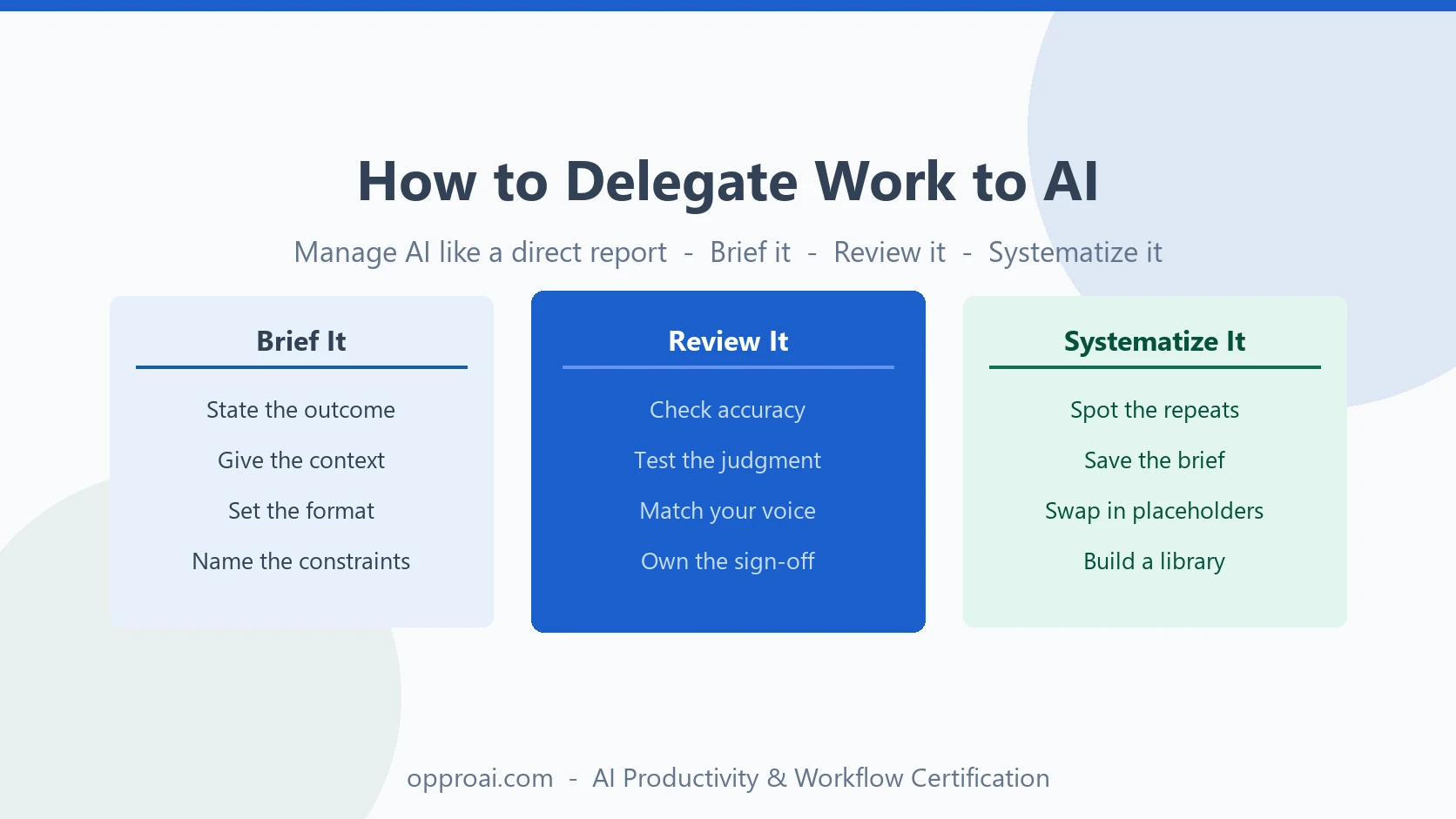
Most professionals use AI like a search engine. They type a question, take whatever comes back, and move on.
The ones getting real leverage do something different. They manage it like a direct report.
That shift sounds small. It is not. It changes what you ask for, how you ask, and what you do with the answer — and it is the single biggest difference between someone who gets generic output and someone who gets work they can actually use.
Here is the useful part: if you manage people, you already have the skill. You know how to take a task off your plate, hand it to someone capable, and get back something usable. Delegating to AI is the same muscle, pointed at a different kind of worker. This is a framework for doing it deliberately.
Why "Delegation" Is the Right Mental Model
When you delegate to a person, you do a few things almost without thinking. You decide the task is worth handing off. You explain what you need and why. You give context the person does not already have. You set the format and the deadline. And when the work comes back, you review it before it goes anywhere.
Now think about how most people use AI. They skip all of it. They type a one-line request, accept the first response, and either use it as-is or give up because "the output was generic."
The output was generic because the brief was generic. The model is not the problem. The delegation is.
Treating AI as a worker you manage — rather than an oracle you query — fixes most of what frustrates people about it. You stop expecting it to read your mind and start giving it what any capable new hire would need to do the job well.
What You Can and Can't Delegate
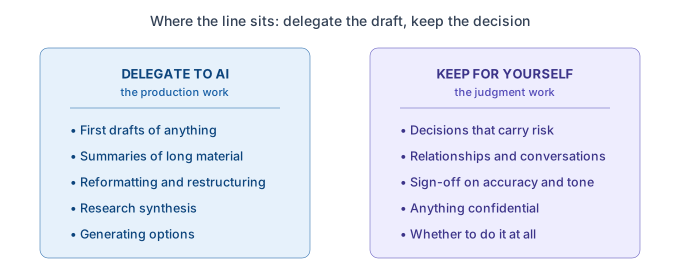
The first job of any manager is knowing what to hand off and what to keep. The same line exists with AI, and drawing it clearly saves you from both under-using and over-trusting the tool.
Delegate the production work:
- First drafts of documents, emails, plans, and updates
- Summarizing long material into the parts that matter
- Reformatting and restructuring something you already wrote
- Synthesizing research and pulling out themes
- Generating options when you are stuck on how to approach something
- Turning rough notes into a clean, structured deliverable
Keep the judgment work:
- The final decision on anything that carries risk
- Relationships and conversations that need a human
- Sign-off on accuracy, tone, and whether it is right to send
- Anything involving confidential information the tool should not see
- The call on whether the task should be done at all
The pattern is consistent. AI is excellent at producing a strong first version of almost anything. It is not a substitute for the judgment that decides whether that version is correct, appropriate, and ready. You delegate the draft. You keep the decision.
The Delegation Framework
Four steps. They map directly onto how a good manager hands off work to a capable person.
1. Decide what to delegate — Is this production work or judgment work?
2. Brief it like a new hire — Give outcome, context, format, and constraints.
3. Review like a manager — Check the work before it leaves your desk.
4. Turn repeats into systems — When you delegate the same thing twice, build a reusable brief.
Step 1: Decide What to Delegate
Before you open a chat window, ask one question: is this something I need to produce, or something I need to decide?
If it is production — a draft, a summary, a reformat, a synthesis — it is a strong candidate to delegate. If it is a decision that carries real consequences, the AI can help you think it through, but the call stays with you.
This is not a small filter. It keeps you from wasting time trying to get AI to do things it is bad at, and it keeps you from outsourcing judgment you should be exercising yourself. Managers who skip this step end up either disappointed (they delegated a decision) or exposed (they trusted a draft they should have reviewed).
Step 2: Brief It Like a New Hire
This is where most of the leverage lives. A capable new hire who is handed a vague task produces vague work. So does AI. A clear brief produces usable work from both.
A good brief has four parts:
Outcome — What does the finished work look like? "A 150-word project update for my VP" is an outcome. "Write something about the project" is not.
Context — What does the worker need to know that they cannot infer? The audience, the situation, the history, the constraints. This is the part people skip, and it is the part that matters most.
Format — Bullet points or prose? How long? What structure? Tell it, or it will guess.
Constraints — Tone, things to avoid, the line you do not want crossed. "Direct but not blunt. Do not over-promise on the timeline."
Here is the difference in practice.
Weak brief:
Write an email to my team about the deadline change.
Strong brief:
Write a short email to my team of six letting them know the client moved the deadline from March 15 to March 1. This is tight but doable if we reprioritize. I need them focused, not panicked. Acknowledge that it's a compressed timeline, be clear that we can hit it, and ask them to flag anything currently on their plate that should be paused. Tone: calm and direct. Under 150 words.
The second version takes thirty extra seconds to write and produces something you can almost send as-is. That is the entire trade. Thirty seconds of briefing for a draft that is actually useful.
If you want a repeatable structure for this, the Build-Refine-Deliver framework is the same idea expressed as a workflow: build a strong first version, refine it through follow-up instructions, then apply your own judgment before it ships.
Step 3: Review Like a Manager
You would never forward a new hire's first draft to your CEO without reading it. Apply the same standard here.
A manager's review is not a proofread. It is a check on the things that actually matter:
- Is it accurate? AI states wrong things with complete confidence. Verify any fact, figure, name, or claim you are not certain of yourself.
- Is the judgment sound? Does the framing make sense for your situation, or did the model produce a generic version that misses the real dynamics?
- Does it sound like you? Or does it have the flat, over-smooth quality that signals it was not written by a person?
- Is it appropriate to send? This is the question only you can answer.
This review step is non-negotiable, and it is exactly where accountability lives. The work goes out under your name, not the model's. We covered the specifics of this in how to review AI output — the short version is that the review is the part of the job that stays human, permanently.
Step 4: Turn Repeats Into Systems
Here is where managers pull ahead. The first time you delegate something, you write the brief from scratch. The second time you delegate the same kind of thing, you should not.
Pay attention to what you ask for repeatedly. Weekly status updates. Meeting recaps. First drafts of a certain kind of email. The moment you notice a pattern, save the brief that worked — with the specifics swapped out for placeholders.
For example, a reusable status-update brief:
Write a weekly status update for [audience]. Here are my raw notes: [notes]. Structure it as: what shipped this week, what is at risk, and what I need a decision on. Keep it under 200 words. Tone: direct, no filler.
Now every weekly update is a thirty-second task instead of a five-minute one. Do this across your recurring work and you build a personal library of delegations — the difference between using AI occasionally and running part of your job through it systematically. This is the habit that separates effective AI operators from people who are still typing one-off questions.
A Note on Accountability
Delegating to a person does not transfer accountability, and neither does delegating to AI. If a direct report sends a flawed report under your name, the flaw is yours to answer for. The same is true here.
This is not a reason to avoid delegating. It is the reason the review step exists. Managers who understand this use AI aggressively for production and guard the sign-off carefully. They get the speed of delegation without giving up the responsibility that makes them trustworthy.
The professionals who will stand out over the next few years are not the ones who use AI the most. They are the ones who manage it the best — who know what to hand off, how to brief it, when to push back on what it produces, and where their own judgment is the thing that cannot be delegated.
If you want to build that skill deliberately — across delegation, briefing, review, and the workflows that make it systematic — the OpPro AI AI Productivity & Workflow Certification is built for exactly this kind of practical, manager-level application.