There are a lot of big claims floating around about AI and the future of work.
Some are too vague to be useful. Some are too speculative to matter yet.
But one data point cuts through the noise:
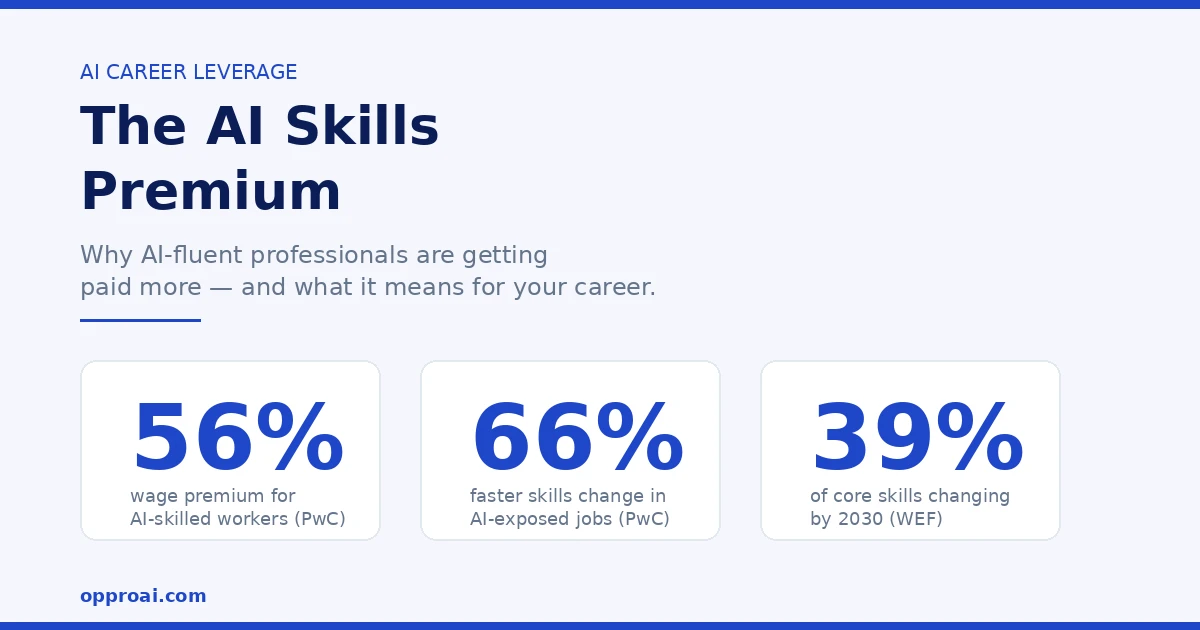
PwC says workers with AI skills command a 56% wage premium. That is up from 25% the year before, according to its 2025 Global AI Jobs Barometer. PwC also says that in jobs most exposed to AI, the skills employers want are changing 66% faster than in less exposed jobs.
That is a real signal.
Not because every professional with a chatbot account is suddenly worth dramatically more. And not because AI guarantees a raise.
It matters because it suggests something broader:
The market is starting to value AI fluency as a real workplace skill.
The Market Is Starting to Price AI Skill Differently
The most important part of the PwC data is not just the number itself. It is what the number represents.
PwC did not frame this as a niche trend limited to one corner of the economy. Its report says workers with AI skills command higher wages on average, and that every industry it analyzed showed wage premiums for AI skills.
That matters because it suggests employers are not only paying for technical AI specialists. They are increasingly paying for people who can create more value in AI-shaped work.
PwC also reports that jobs more exposed to AI have not simply collapsed. In its 2025 findings, job availability in more AI-exposed roles still grew, even if at a slower pace than in less exposed roles.
So the story is not just "AI replaces jobs." It is also: "AI changes what kinds of skills inside those jobs become more valuable."
Why Companies Are Paying More for AI-Fluent Professionals
A wage premium usually shows up when the market sees some mix of scarcity and value. That is likely part of what is happening here.
PwC's framing is that workers with AI skills bring measurable value, and the same report says industries more exposed to AI saw stronger growth in revenue per employee than less exposed industries.
In plain English: if someone can use AI to produce better work, faster, with more leverage, that changes how valuable they become.
That does not mean every use of AI creates value.
But it does mean professionals who can reduce blank-page time, structure messy information, summarize faster, improve communication quality, build repeatable workflows, and use AI with judgment rather than guesswork are becoming more useful to the organizations they work in.
And useful people tend to be valued more.
What "AI Skill" Actually Means for Most Professionals
This is where a lot of people get confused.
They hear a statistic like "56% wage premium" and assume it must only apply to people doing highly technical work. But that is too narrow.
For many professionals, "AI skill" does not mean training models or building infrastructure. It often means being able to use AI well in the work you already do.
That can look like writing stronger first drafts, turning meeting notes into action items, organizing priorities faster, analyzing large amounts of information, improving reports and summaries, and building lightweight workflows around recurring work.
In other words, for a lot of modern office work, AI skill is increasingly less about theory and more about applied fluency.
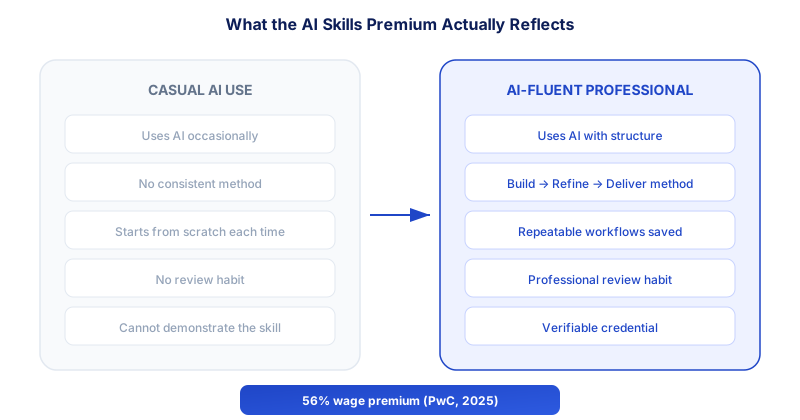
The professionals who create the most value with AI are often not the people who know the most jargon. They are the people who know where AI fits, how to prompt clearly, how to refine outputs, how to build repeatable systems, and when human judgment still needs to lead. That is what it means to be an AI operator.
Why This Matters Even If You Are Not in Tech
One of the most encouraging parts of PwC's data is that the wage premium is not described as isolated to one industry. PwC says every industry it analyzed paid wage premiums for AI skills.
That makes this relevant to managers, analysts, operators, project leads, marketers, finance professionals, healthcare professionals, and knowledge workers across many functions.
It also lines up with a broader workforce trend. The World Economic Forum says employers now expect 39% of workers' core skills to change by 2030, which makes AI fluency feel less like an optional experiment and more like part of a larger skills shift already underway.
Even if your exact role does not become "AI-first," the ability to work well alongside AI is becoming more important. That is what makes this a professional issue, not just a tech issue.
What Professionals Should Do With This Information
The point of this data is not to obsess over a number. It is to take the market signal seriously.
If employers are increasingly rewarding AI skill, then the practical question becomes: What kind of AI skill is actually worth building?
A good answer is: skill you can use in real work, skill that improves output and leverage, skill that helps you build repeatable workflows, skill that strengthens judgment instead of replacing it, and skill you can actually demonstrate — not just claim.
That is the difference between casual AI usage and real AI fluency. And that is where professionals have an opportunity.
Not everyone needs to become deeply technical. But more people probably do need to become AI-capable in a practical way. That is what the market appears to be rewarding.
The strongest takeaway from the AI skills premium is not "learn AI because it is trendy." It is: the market is starting to reward professionals who can create real value with AI.
That value does not come from hype. It comes from capability. The professionals who are most likely to benefit are the ones who can use AI to improve how work gets done — clearly, practically, and responsibly.
If you want to build that kind of practical AI fluency, OpPro AI's AI Productivity & Workflow Certification is designed to help working professionals strengthen the workflows, prompting habits, and judgment that matter in real work.