AI is in your meeting tools, your writing tools, your email platform, your analytics dashboard, and probably three other places you forgot about.
But having AI everywhere is not the same as getting value from AI anywhere.
Most companies have invested in the technology. Fewer have figured out what to actually do with it. And almost none have built the internal training, workflow redesign, or management support that turns AI access into AI results.
That leaves working professionals in a weird spot. Your company is probably talking about AI. You might even have access to several AI tools. But nobody has shown you how to use them well — or what "well" even looks like in your specific role.
AI fails at most companies because organizations treat it like a software rollout instead of a skill-building problem. They buy tools without redesigning workflows, encourage employees to "use AI" without teaching them how, and leave adoption scattered and informal. For individual professionals, the move is to stop waiting for company-wide training and start building practical AI fluency through better prompts, repeatable workflows, and a strong review habit.
This gap between AI investment and AI fluency is where most workplace AI efforts quietly stall. And for professionals who recognize it, the gap also creates a real career advantage.
The Adoption Gap Is an Execution Problem
The issue isn't awareness. Every company knows AI matters.
The issue is that knowing AI matters and knowing how to make AI useful inside actual work are completely different problems.
Gallup's 2026 workplace research found that employees who use AI frequently report productivity gains — but evidence of organization-wide work transformation remains limited.
That gap shows up everywhere. Companies buy licenses, run pilots, send out encouraging Slack messages. Meanwhile, most employees are still copy-pasting into ChatGPT with no real structure and getting back mediocre results that confirm their suspicion AI "isn't that useful."
The tool isn't the bottleneck. The missing piece is training, workflow integration, and clear expectations about what AI should actually improve.
How AI Stalls Out Inside Organizations
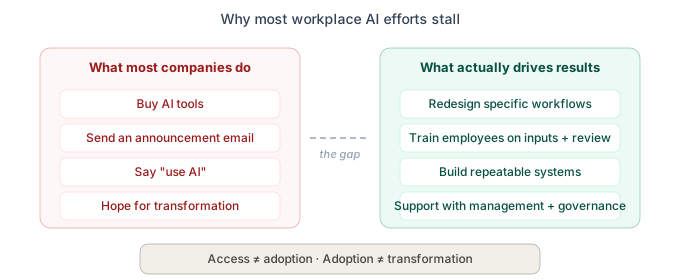
There's no single reason AI fails at work, but a few patterns show up repeatedly.
Tools arrive before workflows change
This is the most common version. A company rolls out an AI assistant, sends an email announcing it, and assumes adoption will follow. It usually doesn't — because employees have no idea which parts of their job the tool is supposed to help with.
AI becomes useful when it's connected to a specific task: preparing a weekly status update, triaging an inbox, turning rough meeting notes into follow-up emails. Without that specificity, it stays generic. And generic AI use rarely sticks.
"Use AI" isn't a strategy
Telling employees to "use AI" without practical guidance is like handing someone a spreadsheet and saying "be data-driven." It sounds supportive but doesn't actually help.
Professionals need to understand how to give AI better inputs, how to structure a prompt for a specific task, how to review what comes back, and how to build something repeatable out of it. That's a trainable skill. But most companies haven't made time for the training.
AI gets used as a shortcut, not a tool
When there's no training, people default to the lowest-effort version of AI use: paste something in, grab the first output, move on. This works occasionally. More often, it produces work that sounds polished but misses context, gets the tone wrong, or includes something subtly inaccurate.
Over time, this erodes trust in AI — not because the tool failed, but because no one learned how to use it past the surface level.
The human side gets ignored
Gartner recently emphasized that organizations need a comprehensive, people-centered AI strategy to retain AI talent and achieve real results.
That resonates because most AI rollouts treat adoption as a technology problem. But the harder challenge is behavioral. People need to understand why AI matters for their specific role, what they're allowed to use it for, how to talk about AI-assisted work with credibility, and how to build confidence through practice — not just access.
Use stays random instead of repeatable
A lot of workplace AI use is one-off. Rewrite this email. Brainstorm ideas for this project. Summarize this document. Each of those is fine on its own, but the bigger value shows up when AI becomes part of a system you run regularly.
The difference between using AI once to write a project update and building a reusable project-update workflow — with consistent inputs, a clear structure, and a review step — is the difference between occasional convenience and durable productivity.
AI Tools Are Moving Faster Than Workplace Training
AI capabilities are advancing on a cycle measured in months. Workplace training programs move on a cycle measured in years. That mismatch is widening.
Gallup found that AI use among U.S. employees continues to rise, but daily use remains limited and adoption is strongly tied to managerial support and role-specific integration.
In practice, that means most professionals are figuring this out alone. Some are experimenting quietly and not sure if they're doing it right. Some tried AI a few times, got underwhelming results, and moved on. Some are waiting for formal company guidance that may not arrive for months.
This is why building your own AI fluency matters — independent of what your company does or doesn't provide.
What You Can Do Without Waiting for Your Company
You don't need to control your company's AI strategy to get better at using AI in your own work. The skills that matter most — writing stronger prompts, building repeatable workflows, reviewing AI output with a critical eye, knowing when AI helps and when it doesn't — are all things you can develop on your own.
If you're looking for a place to start, we've written practical guides on several of these:
-
What Is an AI Operator? explains the emerging skill set that separates professionals who use AI casually from those who use it as a real productivity system.
-
The Build-Refine-Deliver Framework walks through a structured prompting method you can apply to almost any work task.
-
How to Use AI Without Sounding Like AI covers how to take AI-generated drafts and make them sound like you actually wrote them.
-
What Is an AI Workflow? explains why single prompts plateau and how to build multi-step systems that compound over time.
The throughline across all of these: AI fluency is a professional skill, not a tech trend. The people who benefit most won't be the ones with the best tools — they'll be the ones who learned how to use the tools well before everyone else caught up.
Why This Matters for Your Career Right Now
When your organization is still figuring out AI, there's a window. Professionals who build real fluency during that window become the people others go to — the ones who draft faster, structure meetings more clearly, catch the problems AI misses, and help their teams work smarter without anyone needing to attend a corporate training seminar.
That's not because AI replaces professional skill. It's because AI, used well, makes existing professional skill more visible and more scalable.
Your company may not have an AI strategy yet. Your career doesn't have to wait for one.
Want to build practical AI fluency before your company figures it out for you?
OpPro AI helps working professionals learn how to use AI in real workplace tasks — from better prompts to repeatable workflows to polished outputs you can actually use.
The AI Productivity & Workflow Certification is designed for professionals who want to move past random experimentation and start building practical AI systems for their work.