There is no shortage of content teaching people how to use AI at work. How to prompt it better. How to structure a request. How to get more out of the tool. Search for it and you will find thousands of guides.
There is almost none teaching people when not to use it.
That gap is not a minor oversight. It is the more expensive skill to be missing. Most people who get burned by AI at work were not burned by a bad prompt. They were burned by using AI in a moment that called for their own judgment instead — and not noticing until the damage was done. Prompting skill determines how good the output is. Judgment determines whether AI should have touched the task at all. The second one is what actually protects your credibility.
Why This Matters More Than Prompting Skill
Picture a manager who needs to announce a reorg. Some roles are being eliminated. People are anxious, and they are going to read every word of that announcement closely. The manager runs it through AI to "tighten the language," and what comes back is clean, well-structured, and completely wrong for the moment — it reads like a product launch. Confident, forward-looking, full of phrases like "exciting new chapter." Nobody who receives that message feels informed. They feel handled.
Or picture a company that had a service failure serious enough to warrant a formal apology to a client. Someone drafts it with AI to save time under deadline pressure, and it goes out mostly as generated. The client can tell. Not because the grammar is off — the grammar is fine — but because the apology has the smooth, generic warmth of something that was never actually upset about what happened. It reads like every other apology on the internet, because in a sense, it is.
Or picture a performance review where a manager pastes in a few bullet points and lets AI write the full narrative. The result is polished and organized. It is also missing the manager entirely — no specific memory of the project that went sideways in March, no actual opinion about where this person should grow next, nothing that could only have come from someone who worked alongside them all year.
In each case, the tool did exactly what it was asked. It produced fluent, coherent text. The failure was upstream of that — a judgment call about whether this particular task, in this particular moment, should have been handed to AI in the first place. That call was made badly, and no amount of prompting skill would have fixed it, because the problem was never the prompt.
The Three-Question Test
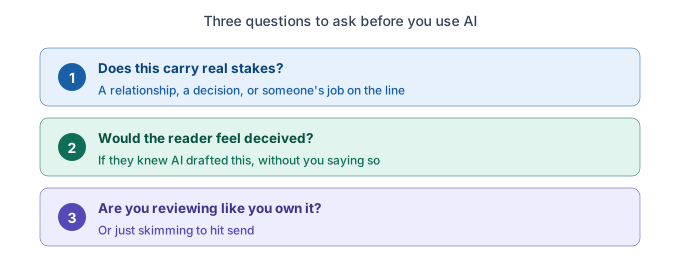
You do not need a long policy document to make this call well. Three questions, asked honestly, catch almost every situation where AI should stay out of it.
1. Does this carry real stakes?
Is a relationship on the line? A decision that affects someone's income, role, or standing? Someone's job, reputation, or trust in you? If the honest answer is yes, that is a signal to slow down, not necessarily to abandon AI entirely, but to treat it as a drafting aid at most and to put your own judgment squarely in charge of the outcome. Low-stakes tasks — an internal FAQ, a meeting recap, a first draft of a routine update — can absorb more automation because a mediocre result costs you a rewrite, not a relationship.
2. Would the reader feel deceived if they knew AI drafted this?
This is the test that catches things prompting skill cannot fix. Some content is fine coming from AI as long as it is accurate and useful — a summary, a status update, an internal explainer. Other content carries an implicit promise that a specific person thought about it, felt something about it, or is personally standing behind it. A condolence note. A personal thank-you. A response to someone who trusted you with a problem. If the recipient would feel misled learning AI wrote it, that is not a tone problem you can prompt your way out of. It is a signal the task itself was the wrong candidate.
3. Am I reviewing this like I own the outcome, or just skimming to hit send?
This question is about you, not the task. The same piece of writing can be perfectly fine or genuinely risky depending on how carefully it gets reviewed before it goes out. If you are skimming for typos and moving on, you have not actually reviewed it — you have proofread it. Ownership-level review means checking the facts, the framing, and whether this is actually what you would say if you had written every word yourself.
A "yes, kind of" on any of these is not a pass. It is a sign to slow down: draft with AI if you want, but do not fully automate the thinking, and put more of your own hands on the final version than you would for routine work.
Categories of Work That Almost Always Fail the Test
Some categories of work fail this test often enough that it is worth naming them directly, so you are not re-deriving the answer from scratch every time.
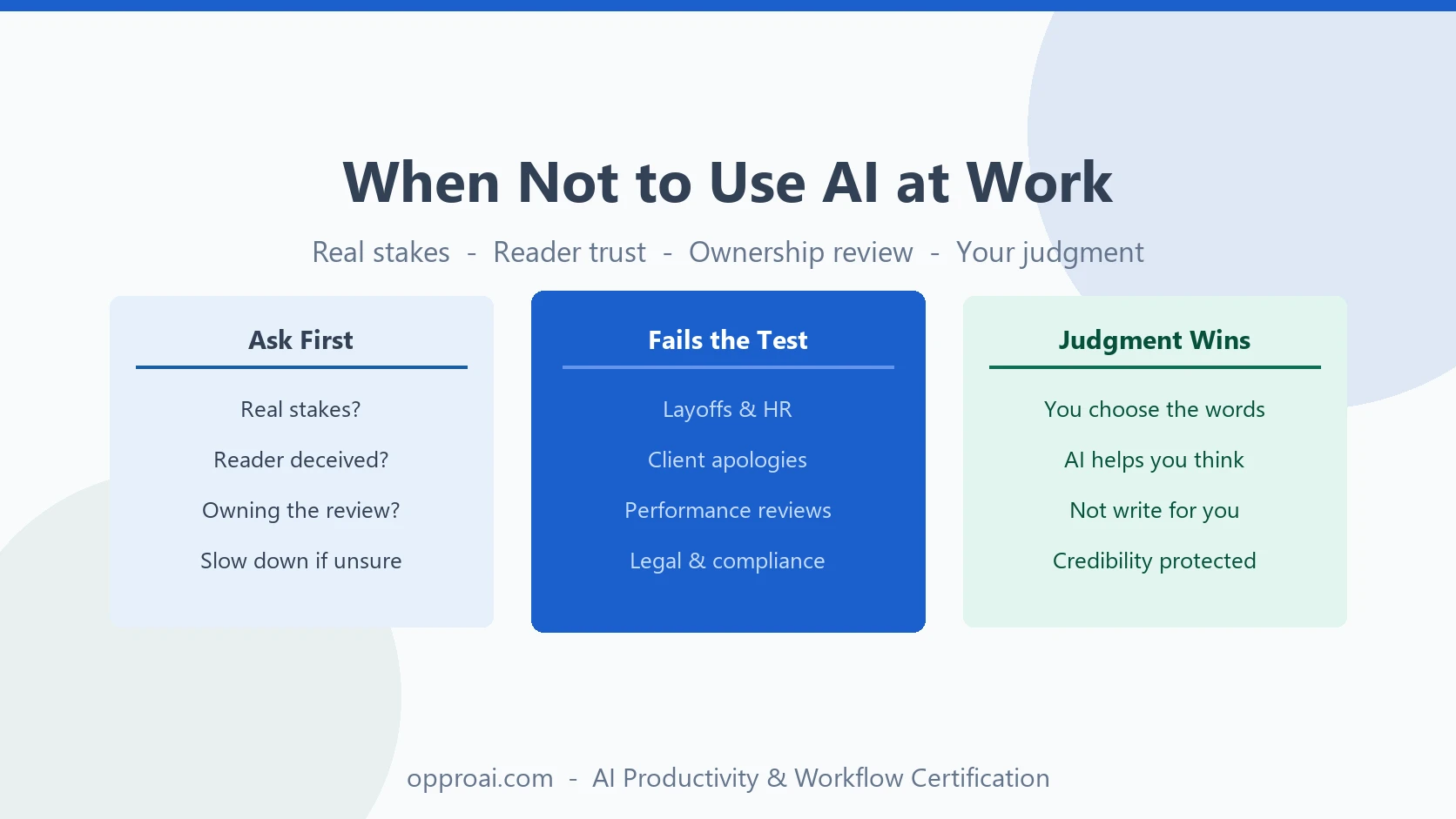
- High-stakes relationship communications. Layoff notices, client apologies after a failure, messages to a person who is upset with you. These carry weight that generic, fluent language actively undermines — the smoothness itself reads as a lack of care.
- HR and disciplinary matters. Performance reviews, termination conversations, disciplinary documentation. These require specific, accountable judgment about an individual, and they often carry legal weight that generic AI phrasing was never built to hold.
- Legal or compliance-adjacent content. Contract language, regulatory communications, anything where a wrong or imprecise word creates real exposure. This is a case where AI assistance without expert review is a liability, not a shortcut.
- Anything requiring personal accountability. Public statements made in your name, commitments you are personally on the hook for, apologies. If you would be expected to answer for every word individually, you need to have actually chosen every word.
- Sensitive personal communications. Condolences, congratulations on something meaningful, conversations with someone going through something hard. These are moments where being seen to have made an effort is the entire point.
None of these are permanently off-limits to AI assistance in every form — AI can still help you organize your thoughts or check a draft for clarity. What they are off-limits to is letting AI generate the substance and sending it close to as-is.
What Good Judgment Looks Like in Practice
Take the client apology scenario and run it through the three-question test properly.
Does this carry real stakes? Yes — a client relationship, possibly a renewal, and the company's credibility after a failure. That alone should slow you down.
Would the client feel deceived learning AI wrote it? Almost certainly. An apology is supposed to signal that a specific person understood what went wrong and is personally accountable for fixing it. Generic AI phrasing undercuts that signal even if every sentence is factually accurate.
Am I reviewing this like I own the outcome? This is where the real decision gets made. If you are treating this as a five-minute task to clear off your list, you are not ready to send anything related to this situation, AI-assisted or not.
Here is what defensible judgment looks like: you might still open AI to get a structural starting point — what should this cover, in what order — because structure is low-stakes. But you would write the actual apology yourself, using specific details about what went wrong and what you are doing about it. AI helped you think faster. It did not write the thing that mattered.
A team lead facing this exact situation used AI to draft three possible openings for the apology, picked none of them outright, and wrote the final version by hand using the best phrase from each — plus a specific line about what changed in their process as a result. The client's reply mentioned that line directly. Nobody remembers a generic apology. People remember specificity.
Building the Habit
Being good at AI is not about using it constantly. It is about knowing exactly where it stops being useful and your own judgment has to take over — and having the discipline to make that call consistently, especially when you are busy and the AI-generated version is sitting right there, done, tempting you to just send it.
This is the same instinct that separates people who use AI well from people who use it a lot. It pairs directly with a good review habit: even for work you do decide to draft with AI, reviewing it properly before it goes out is what catches the cases where your first instinct about the stakes was wrong. Judgment decides whether to use the tool. Review is the backstop for when that judgment needs a second check.
The professionals who build a real reputation with AI over time are not the ones who automate the most. They are the ones whose colleagues never have to wonder whether what they are reading actually came from them.
If you want to build this judgment deliberately — alongside the delegation, review, and workflow skills that make AI use genuinely reliable at work — the OpPro AI Productivity & Workflow Certification is built around exactly this kind of practical, applied decision-making.