Marketing has an unusual AI problem: it's the function where AI is easiest to use badly and get away with it — for a while.
A marketer can generate a week of social captions, three email variants, and a landing page draft in an afternoon. The volume goes up immediately. What takes longer to show up is the cost: content that reads like every other AI-generated post, a brand voice that's quietly gone flat, and an audience that's started scrolling past without noticing.
The marketers getting real leverage from AI aren't the ones generating the most. They're the ones who treat AI as a first-draft engine and keep tight control over the two things AI can't do for them: the brief, and the final edit.
Where AI Creates Leverage in Marketing
AI is strong at producing volume and variation from a clear brief. It's weak at knowing your brand's actual voice, your audience's actual objections, and what's strategically true about your market this quarter.
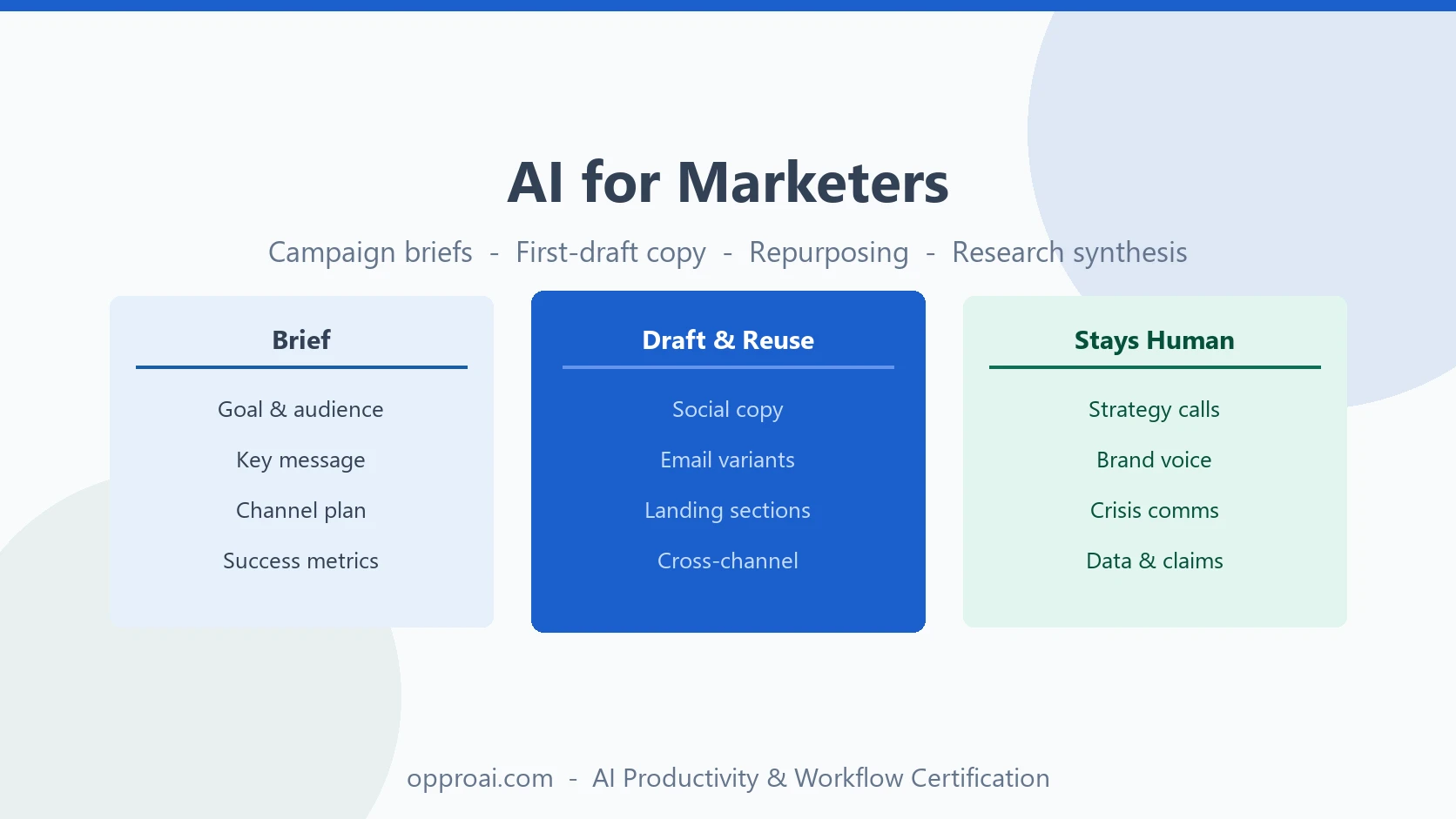
The highest-leverage zones:
- Campaign briefs — turning a rough goal into a structured brief a team (or AI) can execute against
- First-draft copy — social posts, email variants, landing page sections
- Repurposing — turning one piece of content into multiple formats across channels
- Research synthesis — condensing competitor content, reviews, or customer feedback into themes
None of these replace strategy, positioning, or brand judgment. All of them remove the blank-page and repetitive-rewrite work that eats a disproportionate share of a marketer's week.
Campaign Briefs
A clear brief is the highest-leverage document in marketing — for a team and for AI. A vague brief produces vague creative from either.
Campaign brief prompt:
I'm planning a campaign for [product/offer]. Goal: [specific, measurable outcome]. Audience: [who, specifically — not "everyone"]. Key message: [the one thing they should take away]. Channels: [list]. Timeline: [dates]. Draft a one-page campaign brief with sections for objective, audience, key message, channel plan, and success metrics.
The inputs in brackets are where the actual strategic thinking lives. AI organizes it into a brief a team can execute against — it doesn't generate the strategy from nothing.
First-Draft Copy That Doesn't Sound Generic
The single biggest mistake marketers make with AI copy is asking for the finished piece instead of asking for a draft to edit hard. The fix is feeding AI your actual brand voice — not asking it to invent one.
Brand-voice copy prompt:
Write a LinkedIn post about [topic]. Our brand voice is [3–4 specific descriptors — e.g., direct, no corporate fluff, occasionally contrarian]. Words we use: [list]. Words we avoid: [list]. Here's an example of a post that sounds like us: [paste a real example]. Match that voice, not a generic professional tone.
That last instruction — pasting a real example — does more to prevent generic output than any amount of adjective-stacking in the prompt. AI pattern-matches to the example far better than it interprets abstract style descriptions.
Then edit hard. The first AI draft is a starting point for rhythm and structure, not a final version. If a post reads like it could have been written by any brand in your category, it needs another pass — see how to use AI without sounding like AI for the specific tells to catch.
Repurposing One Asset Into Many
Content repurposing is one of the clearest wins in marketing AI use, because the strategic thinking is already done — the work is translation across formats.
Repurposing prompt:
Here's a blog post I published: [paste post or link]. Turn it into: (1) a LinkedIn post with a strong hook and a soft CTA, (2) a 4-slide Instagram carousel outline with one idea per slide, (3) three standalone tweet/thread openers based on the strongest claims in the piece. Keep the core argument intact — don't dilute it into generic takeaways.
The instruction to preserve the core argument matters. Left alone, AI repurposing tends to sand down the sharpest, most specific claims in a piece into safer generalities — which is exactly the content that gets scrolled past.
Research and Competitive Synthesis
Marketers spend real time reading competitor content, reviews, and customer feedback to find patterns. AI is useful for compressing the reading, not for replacing the read.
Synthesis prompt:
Here are [customer reviews / competitor landing pages / survey responses]: [paste]. Identify the 3–5 most common themes, with a representative quote or example for each. Flag anything surprising or contrary to what we'd expect.
Always spot-check the synthesis against the raw source before acting on it. AI is good at pattern-finding across text and occasionally overconfident about a "theme" that's really one loud outlier.
What Stays With the Marketer
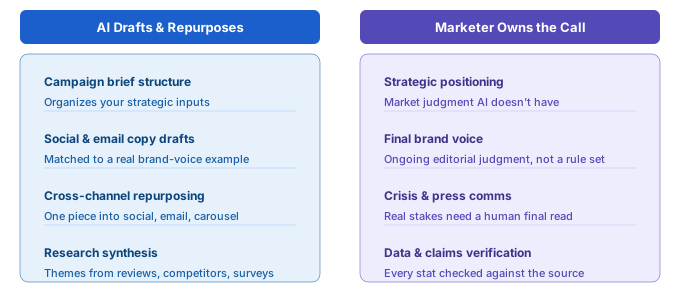
AI should never own:
- Strategic positioning. What you claim, who you're for, and what you're against are calls that require market judgment AI doesn't have.
- Brand voice, final say. AI can match a voice you feed it. It can't decide what your voice should be, or catch it drifting over time — that's an ongoing editorial judgment.
- Anything published under real stakes. Press statements, crisis communications, executive-attributed content, and anything with legal or reputational exposure needs a human final read, every time.
- Claims and data. Any statistic, customer number, or competitive claim in AI-drafted copy needs to be verified against the actual source before it ships. AI states wrong numbers as confidently as right ones.
The shape of good AI use in marketing is consistent: AI produces volume and first drafts fast. The marketer's job is the brief that shapes the output and the edit that makes it actually sound like the brand.
Building a Marketing Prompt Library
Marketers getting consistent value from AI keep a small set of proven prompts, refined once and reused constantly:
- Campaign brief template
- Brand-voice social post (with a real example baked into the prompt)
- Email variant generator (subject line + body, 3 versions)
- Content repurposing (blog → social → email)
- Competitor or review theme synthesis
Each of these takes a few iterations to dial in against your specific brand voice, then compounds every time it's reused. That's the same Build → Refine → Deliver discipline that applies everywhere else AI touches real work — draft fast, refine with judgment, ship only what you'd put your name on.
The OpPro AI AI Productivity & Workflow Certification covers exactly this: how to brief AI like a capable new hire, review its output before it ships, and build the reusable systems that make the speed compound instead of flatten your work into sameness.