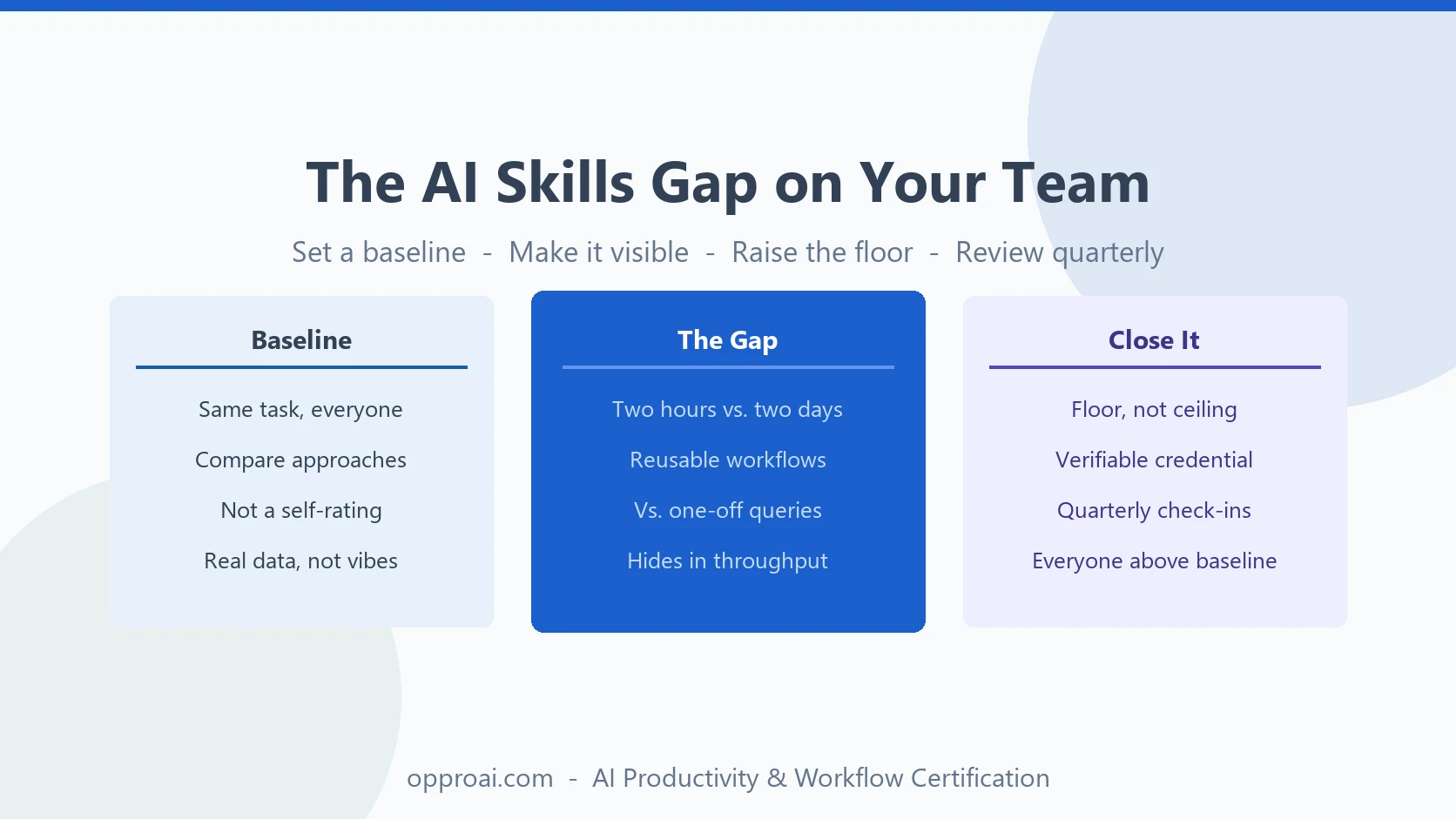
Most managers have the same blind spot. They assume their team's AI skill level averages out to "fine" — some people are probably ahead, some are probably behind, and it roughly nets out to good enough. It doesn't.
On nearly every team, there is a small group who have quietly rebuilt how they work around AI. They have saved prompts, structured workflows, and a habit of reaching for AI as a first step on the right kind of task. And there is everyone else, still using it the way they used a search bar three years ago — one question at a time, no memory of what worked last time, no system underneath it. That gap is real, it is usually wider than managers think, and it does not show up anywhere a typical performance review would catch it.
This matters more than it sounds like it should, because the gap compounds. A person who has built a handful of reusable workflows is not just faster on any single task — they are freed up to take on more work in the same number of hours, which shapes what they get assigned, which shapes how they are perceived, which eventually shapes who gets promoted. None of that traces back cleanly to "AI skill" on paper. It just looks like some people are more productive than others, for reasons nobody bothered to investigate.
What the Gap Actually Looks Like
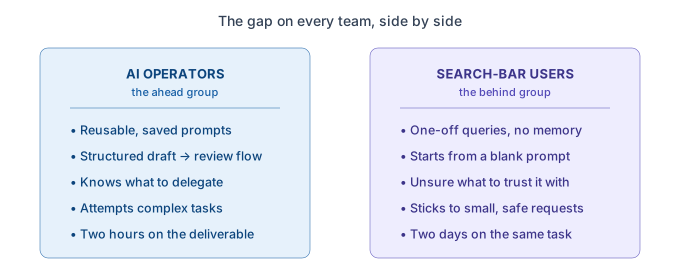
The gap does not show up as a skill listed on a resume or a line item in a review. It shows up in throughput. It shows up in who finishes a deliverable in two hours and who takes two days on a task that is, on paper, the same difficulty.
The practical difference usually comes down to a few habits. People on the ahead side of the gap have reusable prompts for the writing they do repeatedly, so a task that used to take twenty minutes takes two. They think in structured workflows — draft, refine, review — rather than treating each request as a one-off. They know what to hand off entirely and what needs their own judgment layered on top. People on the other side are still typing a fresh, generic question into a chat window every time, getting a generic answer, and either accepting it as-is or giving up and doing the task manually because "AI didn't really help."
Neither group is lazy or incapable. The gap is almost entirely about exposure and habit, not raw ability — which is actually good news, because habits are the kind of thing you can deliberately close a gap on.
It also shows up in the kind of work each group is willing to attempt with AI in the first place. Someone with a structured workflow will use AI to produce a full first draft of a complex deliverable, because they know how to brief it and how to review what comes back. Someone without that workflow tends to stick to small, safe requests — a single paragraph, a quick rewrite — because their few attempts at anything bigger came back generic or wrong, and they never built the habit of pushing past that first disappointing result. The gap is not just speed. It is the size of the task each person believes AI can actually help with.
Why the Gap Goes Unmeasured
Most teams have never had a shared standard for what "good at AI" actually looks like. Skill develops randomly, based on who happened to be curious enough to experiment on their own time, who stumbled onto a workflow that worked, or who had a coworker show them a trick in passing.
This is not a hiring problem — you likely already have the right people. It is not even purely a training problem, though training is part of the fix. At its root, it is a measurement problem. If you have never had everyone attempt the same task and compared the results side by side, you genuinely do not know where your team stands. You have impressions, not data — and impressions tend to be shaped by who is loudest about using AI, not who is actually best at it.
There is also a quieter reason managers avoid measuring this: it is uncomfortable. Asking a team to demonstrate AI skill side by side can feel like it is putting people on the spot, especially senior people who are used to being the ones with the answers. That discomfort is understandable, but it is also exactly why the gap persists. A team that never measures this stays comfortable and stays behind. A team that measures it, even imperfectly, gets a real starting point to work from instead of a guess.
How to Set a Real Baseline
The most direct way to find the real gap is unglamorous: give everyone on the team the same realistic task — something close to actual work, not a toy example — and have them work through it using AI however they normally would. Then look at the approaches side by side, not just the outputs. You will typically see a wide spread: some people produce a finished, well-structured deliverable in a fraction of the time; others produce something rough, or spend the same time they would have spent without AI at all.
This is also where a verifiable credential earns its keep over a self-assessment. Asking people to rate their own AI skill in a one-on-one produces exactly the number you would expect — everyone rates themselves as "pretty comfortable," and the rating is impossible to compare across the team or verify against anything real. A credential that requires demonstrating actual skill against a real bar gives you a common reference point that cannot be inflated in conversation, and it gives your team members a way to prove capability that does not depend on how well they talk about their own work.
A simple version of the baseline exercise: pick a task every role on the team already does regularly — summarizing a document, drafting a client-facing update, turning notes into a plan — and give everyone the same raw input with a thirty-minute window. Do not tell them how to approach it. Then compare not just the final output, but the process: who had a prompt ready to go, who reviewed their result before calling it done, who spent the thirty minutes fighting with a vague first attempt. That comparison tells you more about your real skill distribution than a year of unstructured observation.
Give Everyone a Floor, Not Just a Ceiling
The goal of closing this gap is not turning every person on your team into a power user. That is neither realistic nor necessary. The goal is making sure nobody is stuck at the baseline level — typing "write an email about X" into a chat window and calling it a day.
A floor means everyone on the team knows how to brief AI with enough context to get a usable first draft, knows to review output before it goes anywhere important, and has at least a couple of reusable prompts for the tasks they do most often. That is a modest bar. It is also a bar that a meaningful fraction of most teams currently fail, quietly, without anyone noticing, because nobody ever checked.
Once the floor is in place, let the ceiling take care of itself — your naturally curious people will keep pushing further on their own, the same way they always have. Your job is making sure the gap between the floor and the ceiling stops being as wide as it currently is.
Raising the floor also changes what you can reasonably expect from the team as a whole. Deadlines, workload distribution, and even hiring plans are all implicitly built on assumptions about how much a person can get done in a week. If half your team is working at a fraction of the speed the other half has quietly reached, those assumptions are wrong, and they stay wrong until someone actually closes the gap rather than just noticing it exists.
Review Quarterly
Skills decay and tools change faster than most training cycles account for. The model your team learned on six months ago is not the model they are using today, and a workflow that was cutting-edge two quarters ago may already be a slower way to do the same task. Treat this as ongoing measurement, not a one-time rollout you check off and move past.
A quarterly check-in does not need to be elaborate. Revisit the baseline exercise, see where the spread has narrowed and where it hasn't, and notice who has quietly fallen behind since the last check. Skills gaps that go unmeasured for a year tend to compound, because the people ahead keep compounding their advantage while everyone else stays flat.
If you manage a team and suspect this gap exists but have never actually measured it, that suspicion is usually correct. The AI skills premium shows what that gap is already worth in the market, and whether an AI certification is worth it walks through what a real credential should verify. For teams specifically, the OpPro AI Productivity & Workflow Certification is built to give managers exactly the baseline this piece describes — a shared, verifiable standard instead of a set of impressions.