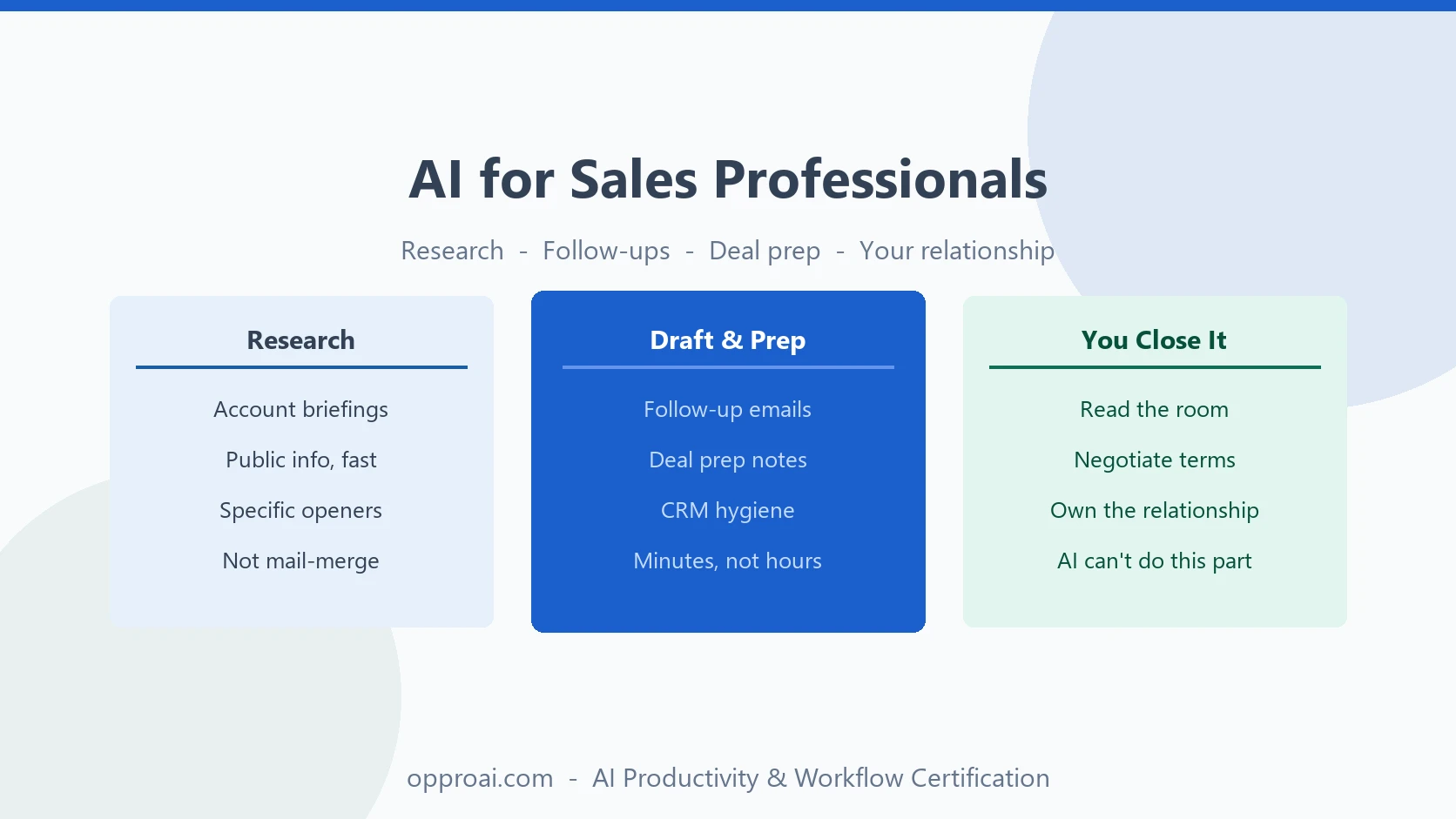
Most sales training focuses on the part of the job that's actually hard to teach: reading a room, handling objections, knowing when to push and when to wait. It rarely focuses on the part of the job that quietly eats the week — researching accounts, writing follow-ups, updating the CRM, prepping for a call that might not even happen.
Multiple sales-productivity surveys, including Salesforce's long-running State of Sales research, have found the same pattern year after year: reps spend well under half their week on direct selling activity. The rest goes to admin, internal tools, and exactly the kind of repetitive writing and research that AI is good at.
That's the actual opportunity AI represents for salespeople. Not replacing the sell — replacing the hours around it.
Where AI Creates Leverage in Sales
AI is strong at research synthesis, first-draft writing, and pattern-spotting across information you already have. It's weak at reading a prospect's tone on a call, knowing which relationship needs a phone call instead of an email, and making the judgment call on how hard to push a discount.
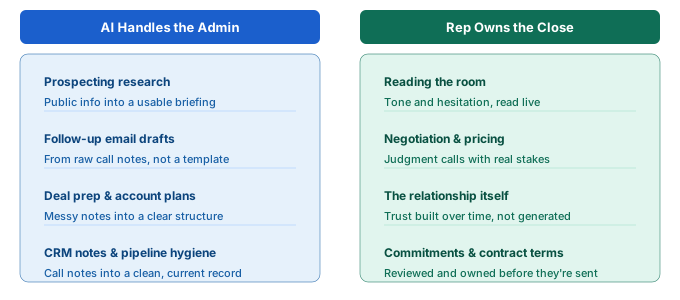
The highest-leverage zones for a rep:
- Prospecting research — turning scattered public information about an account into a usable briefing
- Follow-up emails — fast, specific first drafts after a call, not generic templates
- Deal prep — organizing what's known about a deal into a structure you can actually think with
- CRM notes and pipeline hygiene — turning call notes into clean, searchable records
None of these close a deal by themselves. All of them free up the hours a rep would otherwise spend on research and writing instead of talking to people.
Prospecting Research That Doesn't Read Like a Mail Merge
The fastest way to make a prospect feel like one of a thousand names on a list is to open with something generic. The fastest way to fix that is to actually know something specific about their business before you reach out — which used to take real time to dig up.
Prospecting brief prompt:
Here's what I know about [company]: [paste website copy, recent news, LinkedIn posts, or a press release]. Summarize their business in two sentences, identify 2-3 likely priorities or pain points based on this information, and suggest one specific, non-generic opening line for a first outreach email that references something real about their situation.
The output is a starting point, not a script. Verify anything specific before you use it — AI will occasionally misread a stale press release or an outdated job title, and sending a prospect an outreach email based on a wrong fact does more damage than sending a generic one.
Follow-Up Emails That Sound Like You Were Actually on the Call
A follow-up written thirty seconds after a call, from memory, usually reads worse than one built from a clear structure — even though it feels faster in the moment.
Follow-up email prompt:
I just had a call with [name/role] about [topic]. Here are my raw notes: [paste bullet notes from the call]. Draft a follow-up email that: restates the 2-3 things they said mattered most to them, confirms the agreed next step and date, and asks one specific question to keep the thread moving. Keep it under 150 words. Don't add generic enthusiasm language.
That last instruction matters more than it looks. Left alone, AI drafts follow-ups full of phrases like "great chatting with you" and "excited about the possibilities," which reads as filler to anyone who was actually on the call. Cutting it is a two-second edit that makes the difference between a follow-up that sounds templated and one that sounds like notes from a real conversation — the same instinct behind using AI without sounding like AI.
Deal Prep and Account Plans
Before a high-stakes call — a renewal at risk, a multi-stakeholder deal, a competitive situation — the useful work isn't writing. It's organizing everything you know into a structure you can think against.
Deal prep prompt:
Here's everything I know about this deal: [paste CRM notes, email threads, call notes]. Organize this into: known stakeholders and their apparent priorities, open objections or risks, what's been promised so far, and 2-3 open questions I still need answered before the next call. Flag anything that looks inconsistent across the notes.
That last instruction — flag inconsistencies — is one of the more genuinely useful things AI does with messy deal history. Different notes from different calls sometimes contradict each other in ways that are easy to miss when you're the one who wrote them all.
CRM Notes and Pipeline Hygiene
CRM updates are the task every rep knows matters and every rep is tempted to skip. AI removes most of the friction between "I just got off a call" and "the CRM reflects what happened."
CRM note prompt:
Turn these raw call notes into a clean CRM update: [paste notes]. Include: call summary (2-3 sentences), stage recommendation with a one-line justification, next step with owner and date, and any risk flags. Keep it scannable for someone who wasn't on the call.
A pipeline that's actually current — because updating it takes ninety seconds instead of ten minutes — is worth more to a sales team than a marginally better forecast model. Accurate, boring data beats sophisticated analysis of stale data every time.
What Stays With the Rep
AI should never own:
- Reading the room. Tone, hesitation, and what a prospect isn't saying out loud are read live, not from a transcript after the fact.
- Negotiation and pricing judgment. How hard to push on a discount, when to hold firm, when a deal isn't worth doing — these are calls that require context AI doesn't have and stakes AI doesn't carry.
- The relationship itself. A prospect can tell the difference between a rep who's genuinely tracking their business and a rep who's running a prompt. AI can inform that tracking. It can't be the relationship.
- Anything promised in a contract or verbal commitment. Terms, pricing, and commitments need a human who's accountable for them — see how to review AI output before sending it for the check that should happen before anything AI-drafted goes to a prospect.
The pattern holds across every use case above: AI compresses the research and writing that surrounds a deal. The rep still runs the deal.
Building a Sales Prompt Library
Reps getting consistent value from AI keep a small set of prompts refined once and reused on every deal:
- Prospecting brief (from public info to a usable summary)
- Follow-up email (from raw notes to a specific, non-generic draft)
- Deal prep and stakeholder mapping
- CRM update (from notes to a clean pipeline entry)
- Objection-handling brainstorm (multiple angles on a specific pushback, reviewed and picked by the rep, not sent as-is)
Each of these compounds the same way any reusable system does — refine it once against your actual deals, and it saves the same twenty minutes every time you use it after that. That's the Build → Refine → Deliver discipline applied to a sales desk: draft fast, refine with judgment, and never send anything to a prospect you wouldn't stand behind yourself.
The OpPro AI Productivity & Workflow Certification covers this exact skill set — briefing AI clearly, reviewing its output before it reaches a client, and building the reusable workflows that turn AI into leverage instead of one more tool to babysit.