Most enterprise AI rollouts follow the same pattern.
There is an announcement from leadership. The tool appears in the toolbar or gets added to the applications list. A training email goes out — maybe a brief demo session. And then most professionals quietly go back to working the way they were working before. They open the AI assistant occasionally, try a few prompts, feel like the output is not quite what they needed, and conclude it is not worth the effort.
This is not an adoption problem. It is an understanding problem.
When professionals understand what enterprise AI tools actually are, how they differ from the AI tools most people first encountered, and what the distinction is between an AI assistant and an AI agent, the confusion drops. The practical value becomes clearer. The skills worth developing become obvious. And the tools start working the way they were supposed to.
This is a plain-language explanation of how enterprise AI works — for the corporate professional who has been handed these tools and wants to use them well.
What Enterprise AI Tools Actually Are
The first thing worth understanding is how enterprise AI tools differ from the general-purpose AI tools most people first tried on their own.
Consumer AI tools are general-purpose. They can help with almost any question or task, but they have no specific knowledge of you, your organization, your data, or your workflows. Every interaction starts without context. The AI is helpful in the abstract but has no view into the environment where your actual work happens.
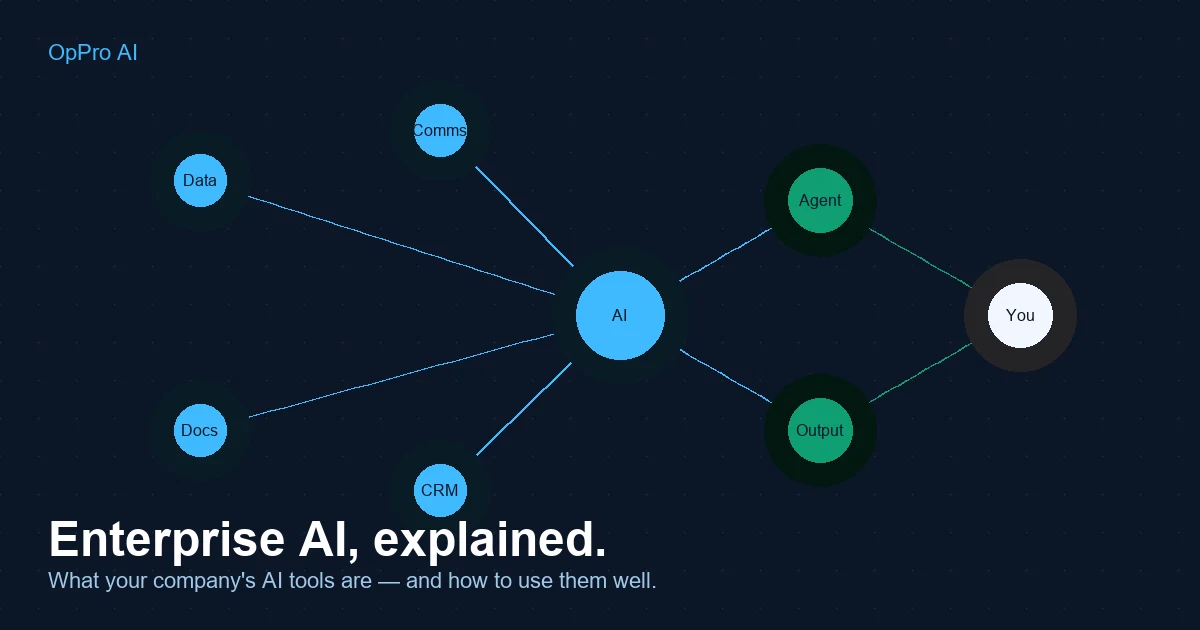
Enterprise AI tools are configured for your organization's environment. They have access to your company's documents, internal knowledge bases, communications, data, and systems. They know who your colleagues are. They operate within your company's security and compliance boundaries. They are connected — to varying degrees, depending on how the platform is deployed — to the workflows where your work actually lives.
That context is what makes the difference. An enterprise AI assistant is not answering questions in the abstract. It is answering questions with access to the actual environment where you work. When it summarizes a document, it can be your document. When it helps you draft a follow-up, it can reference the project context behind it. When it pulls information, it is pulling from inside your organization rather than from the general internet.
This is why enterprise AI tools have real potential to change how corporate work gets done — and why the skills for using them effectively matter more than the specific platform.
The Two Types of Enterprise AI: Assistants and Agents
Most enterprise AI tools fall into one of two categories, even if the distinction is not always spelled out clearly.
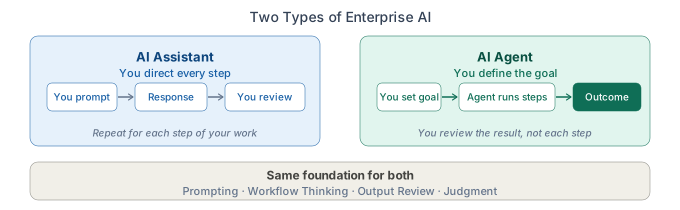
AI assistants are interactive tools you work with one step at a time. You give a prompt, it returns a response. You refine the prompt, it adjusts. You are directing the work at every step. The AI enhances what you do, but it does not take initiative or act independently.
Most professionals who have used enterprise AI have worked primarily with assistants. Chat interfaces, document summarization features, drafting tools, and search-enhanced research aids all fall into this category. The interaction is always: you ask, it answers, you decide what to do with what comes back.
AI agents are different in one important way: they can take a goal and execute a series of steps toward it without waiting for a human instruction at each stage.
An agent is not just responding to a prompt. It is pursuing an outcome. It can break a task into subtasks, decide which tools or data sources to use, take actions across systems, and work through a sequence of steps to deliver a result. You define what you want. The agent figures out how to get there and returns something for you to evaluate.
This is not a technical distinction that only affects developers. It has direct implications for what you give these tools, how you evaluate what comes back, and what skills make the difference between effective use and frustrating use.
What Enterprise AI Agents Can Actually Do
The easiest way to understand agent capability is the difference between a single step and a workflow.
An AI assistant handles steps. You ask it to summarize a document, and it summarizes a document. You ask it to draft an email, and it drafts an email. You are the workflow — you decide what comes next at every point.
An agent handles workflows. You define a goal or describe a process, and the agent determines the steps, executes them using the tools available to it, and delivers a result. You review the outcome, not each intermediate action.
In a corporate environment, this creates practical value in a few specific areas.
Administrative and coordination workflows. Multi-step processes that consume significant time but require limited judgment — scheduling chains, record updates, routing, standard communications — are natural candidates for agent handling. The agent can run the sequence; the professional reviews the result.
Research and synthesis chains. Producing a useful briefing or summary often requires pulling information from multiple sources, extracting the relevant pieces, and assembling them into a structured form. An agent can handle the gathering and organization; the professional reviews and acts on it. What once took two hours of manual work becomes twenty minutes of review and refinement.
Process automation with human checkpoints. Many enterprise processes have steps that can be automated and steps that require a human decision. Agents can handle the execution steps while surfacing the right information at precisely the right moment for the human judgment calls.
Cross-system coordination. Most corporate professionals work across multiple systems every day. Agents that can operate across those systems — pulling data from one, triggering an action in another, updating a third — reduce the manual coordination work that quietly fills a large portion of the average workday.
Monitoring and triggered responses. Agents can be configured to watch for specific conditions in your systems and initiate a defined response when those conditions are met — an incoming request type, a status change, a threshold crossed — reducing the active monitoring any individual has to do.
In every one of these cases, the agent handles the execution. The professional defines what success looks like, reviews what the agent produces, and makes the judgment calls that require business context. The human does not disappear from the workflow. The human's role shifts to a higher level.
Why Enterprise AI Tools Underperform Without the Right Skills
Here is what consistently happens when organizations deploy enterprise AI without building skills alongside it.
Professionals get access to the tool. They try it with the prompts that come to mind naturally — the same way they might type a search query or send a message to a colleague. The output does not quite match what they needed. They conclude the tool is not that useful for their specific work. Adoption stalls.
The tool is rarely the problem.
Enterprise AI tools — whether assistants or agents — perform in proportion to the quality and clarity of what you give them. A vague prompt to an AI assistant produces a vague draft. A poorly defined task handed to an agent produces a poorly executed workflow. The connection between input quality and output quality is direct and consistent.
The professionals who get consistent value from enterprise AI are not necessarily the ones with the most sophisticated tools or the most access. They are the ones who know how to work with AI well regardless of which tool is in front of them.
That means prompting with enough structure that the AI has what it needs to produce something useful — using the kind of Role-Task-Format approach that turns vague requests into structured briefs. It means defining tasks clearly enough that an agent can execute without filling gaps with assumptions. It means building repeatable workflows around the tasks that recur in their role. And it means reviewing what comes back before it goes anywhere, with the same professional standard they apply to their own work.
These are not enterprise AI skills. They are professional AI skills that apply across every tool and every platform. The professionals who build them get value from every AI system their organization deploys. The ones who do not will keep getting weak output and concluding that enterprise AI is overhyped — when the gap was never the tool.
The Foundation That Makes Any Platform More Effective
This is where most corporate AI training falls short.
Enterprise AI onboarding typically focuses on the platform. Here is where to find the feature. Here is what it can do. Here is a quick demo. It treats AI capability as a product to learn rather than a skill to build.
What actually determines whether a professional gets sustained value from an enterprise AI platform is the foundation underneath it: the ability to prompt with structure, think in workflows, review output with judgment, and build repeatable systems around the tasks that matter most.
A professional with that foundation will get more out of any enterprise AI platform than one without it. When the organization switches platforms — and it will — that foundation transfers. When more capable tools are deployed, the transition is natural rather than disorienting. When AI agents take on more of the execution, the ability to define work clearly and review what comes back becomes even more important, not less.
The Build-Refine-Deliver framework is one practical example of this kind of foundation — a way of treating every AI interaction as a structured workflow rather than a one-shot attempt. It works with every enterprise AI assistant. It applies even more when you start directing AI agents.
This is also what it means to be an AI Operator in a corporate context — not mastering a specific platform, but building the judgment and habits that make any platform more effective. The professionals who develop this foundation will consistently outperform the ones waiting for better tools.
If your company has rolled out enterprise AI tools and you are not getting consistent value from them yet, the gap is almost never the platform. It is the foundation underneath the way you use it.
Want to build that foundation?
The OpPro AI AI Productivity & Workflow Certification covers the practical skills that make any enterprise AI platform more effective — structured prompting, workflow design, output review, and the judgment that separates strong AI use from weak use. Self-paced, about two hours, verifiable credential.