AI is entering the workplace quickly.
Employees are using it to draft emails, summarize meetings, analyze documents, prepare reports, brainstorm ideas, organize projects, and improve communication. Companies are encouraging experimentation. Productivity suites are adding AI assistants. Managers are asking teams to "use AI more."
But there is a hidden risk inside this shift:
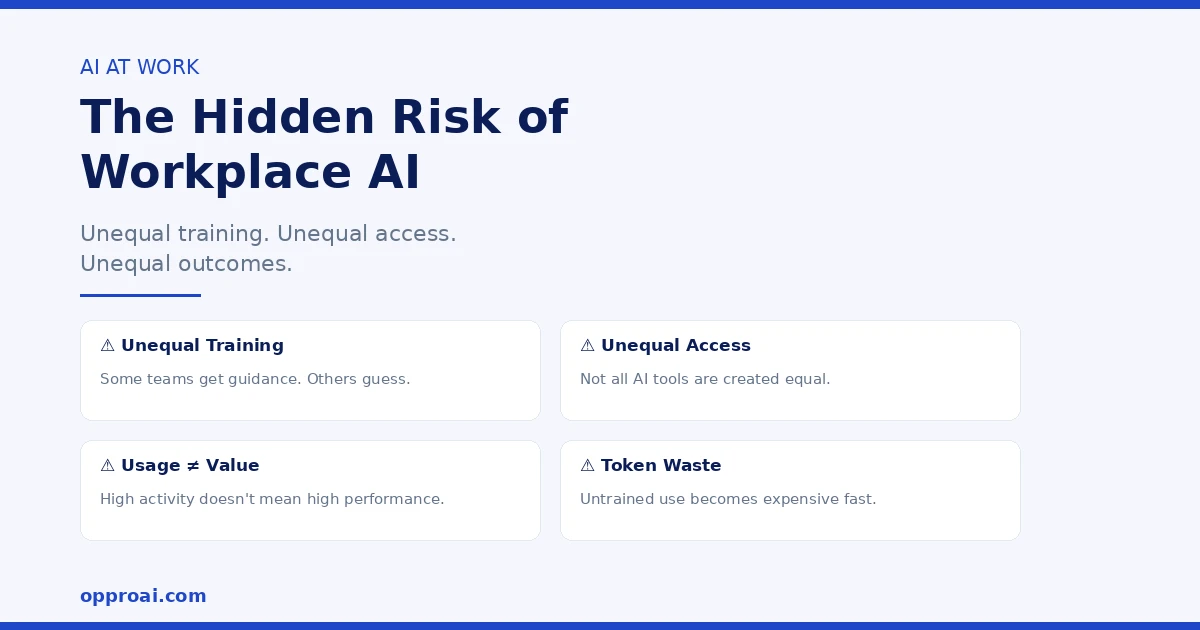
Not everyone is getting the same AI advantage.
Some employees have access to better tools. Some teams receive clearer guidance. Some managers encourage AI use, while others discourage it. Some colleagues know how to prompt, refine, and review AI outputs. Others are left guessing.
Over time, that creates more than a productivity gap. It creates a fairness gap. If AI becomes part of how work gets done, then unequal AI training and unequal AI access can lead to unequal workplace outcomes.
That is why standardized AI training matters.
AI Is Becoming Workplace Infrastructure
AI is no longer just a personal productivity experiment. It is becoming part of workplace infrastructure — like email, spreadsheets, and project management tools.
As AI becomes embedded into the software employees already use, the question shifts from "Should people use AI?" to "How should people use AI responsibly, consistently, and effectively?"
That shift changes the responsibility of the organization. When AI is optional experimentation, uneven use is expected. But when AI becomes part of how teams communicate, analyze, decide, and produce work, companies need shared standards. Otherwise, employees are not working from the same operating system.
The New Workplace Divide Is Not Just Access — It Is Capability
The AI divide at work is not only about whether someone has a tool. It is about whether they know how to use it well.
One employee may use AI to turn rough meeting notes into a polished follow-up, identify risks, draft next steps, and create an executive-ready update. Another employee may paste in a vague prompt, get a generic response, and decide AI is not useful. A third may avoid AI entirely because they are unsure what is allowed.
All three employees technically work in the same company. But they are not operating with the same capability.
That matters because AI can affect speed, output quality, confidence, visibility, career mobility, manager perception, and team productivity. Without standardized training, workplace AI can become another uneven advantage — quietly rewarding the people who already know how to use it and quietly disadvantaging those who do not.
Tool-Version Inequality Is a Real Ethical Issue
There is another layer companies need to consider: not all AI access is equal.
One employee may have access to an enterprise-grade AI assistant connected to approved workplace tools. Another may only have access to a limited free version. One team may have a model with better reasoning, larger context windows, and stronger privacy protections. Another team may be restricted to basic functionality.
That raises difficult questions. Are employees being evaluated equally if they are not equally equipped? Is one employee more productive because they are more skilled, or because they have a better tool? Should comparable roles have comparable AI access?
These questions are not just technical. They are ethical. If AI affects performance, then AI access becomes part of workplace fairness. A company would not expect some employees to build financial models in modern software while others use outdated tools with missing functions. The same logic increasingly applies to AI.
Unequal AI Training Creates Unequal Outcomes
Training is where the gap becomes most visible.
Some employees are naturally curious and will teach themselves. Some will have managers who model good AI use. Some will have colleagues who share prompts, workflows, and examples. Others will not.
If companies leave AI fluency to chance, the result is predictable: AI capability will cluster around the people who already have the time, confidence, permission, and support to experiment. That may deepen existing workplace inequalities — employees in strategic roles may get more AI exposure while operational or frontline teams get left behind.
This is why training cannot be treated as a nice-to-have. If AI changes how work gets done, then AI training is part of workplace equity.
AI Usage Metrics Can Measure Activity, Not Value
Companies are beginning to measure AI usage more formally. Microsoft 365 admin dashboards track Copilot adoption, active users, and prompt activity. OpenAI's enterprise workspace analytics show engagement across teams. Anthropic provides usage and cost APIs for monitoring token consumption.
These tools are useful. But there is a risk in confusing AI usage with AI value.
High usage does not always mean high performance. A colleague who sends hundreds of prompts may not be creating better work — they may be stuck in low-quality iteration, overusing AI for tasks that do not need it, or generating outputs that still require heavy review. Another colleague may use AI less frequently but more strategically, building reusable workflows and creating outputs that save time for the broader team.
The better questions are not "Who used AI the most?" but rather: Did AI improve the quality of the work? Did it reduce unnecessary rework? Did it help employees move faster without lowering standards? Was the work reviewed responsibly? Did the AI-assisted workflow become repeatable?
If companies measure only volume, they may reward the wrong behavior.
Token Maxing Is Not the Same as Productivity
There is also a cost issue hiding underneath workplace AI adoption: token usage.
Many AI systems consume tokens when users submit prompts, upload context, generate responses, or run multi-step workflows. As companies scale AI across hundreds or thousands of employees, token consumption can become a meaningful business expense.
This matters because poorly trained AI use can become expensive. Employees may paste too much context into every prompt, regenerate outputs repeatedly instead of learning to refine clearly, use advanced models for simple tasks, or build inefficient workflows that consume large amounts of tokens without producing meaningful business value.
This is the problem with token maxing — employees consuming large amounts of AI usage capacity without creating proportional value. A company may see high AI consumption and assume adoption is strong. But high consumption could also mean inefficient usage, poor prompting, unclear workflows, or lack of training.
More AI usage does not automatically mean more AI value. Without standardized training, organizations risk paying for activity instead of outcomes. As AI demand and token uptake increase, this becomes more than an individual productivity issue — it becomes a corporate resource allocation issue.
The Real Metric Should Be AI-Enabled Work Quality
If companies want to evaluate AI adoption responsibly, they need to move beyond volume-based metrics.
Prompt counts, active-user rates, and token consumption can show whether employees are touching the tools. They do not prove that the tools are improving the work.
A better approach is to measure AI-enabled work quality: time saved on recurring workflows, reduction in manual rework, quality of final outputs, improved consistency across teams, stronger first drafts, better documentation, clearer decision support, fewer unnecessary regenerations, and more efficient use of the appropriate model for each task.
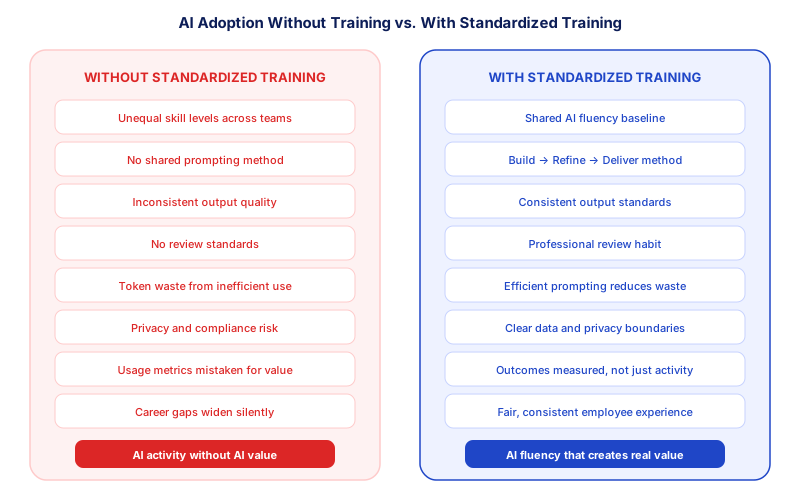
This is where training becomes essential. Employees need to know how to use AI efficiently, not just frequently. That is the difference between AI adoption and AI fluency. Adoption means people are using the tool. Fluency means people are using it well.
What Standardized AI Training Should Include
A strong baseline AI training program should include seven core areas:
1. AI Literacy — What generative AI is, what it can do, what it cannot do, and why it sometimes produces incorrect outputs.
2. Approved Tool Use — Which tools are approved, which are not, and what privacy protections are in place.
3. Data Boundaries — Clear guidance on what information can be entered into AI systems and what should never be shared.
4. Prompting and Workflow Basics — How to provide context, define outputs, refine drafts, and build repeatable workflows using a method like Build → Refine → Deliver instead of random one-off prompts.
5. Output Review — How to review AI-generated work for accuracy, tone, bias, missing context, sensitivity, and usefulness.
6. Efficient AI Use — When AI is appropriate, how much context to provide, how to avoid unnecessary regeneration, and how to match the tool or model to the task.
7. Human Accountability — AI can assist work, but humans remain accountable for decisions, communications, and final outputs.
This foundation should be available across the organization. Departments can build role-specific workflows on top of it. The baseline is what creates consistency.
Managers Need a Shared AI Language
Managers play a critical role in AI adoption. If one manager tells employees to use AI aggressively and another tells employees to avoid it entirely, the company creates confusion.
Employees need consistent answers to basic questions: Can I use AI for this task? Which tool am I allowed to use? What data can I include? Do I need to review every output? Should I disclose AI assistance? How will AI-assisted work be evaluated?
Managers cannot create consistency if they are also improvising. They need shared language, shared expectations, and shared standards. Without that, AI adoption becomes uneven across teams — one group may develop strong AI operator habits, another may avoid AI, and another may overuse it in ways that increase cost without improving outcomes.
AI Training Is a Risk-Management Issue
Companies often think about AI training as a productivity investment. That is true. But it is also a risk-management requirement.
Without proper training, employees may input confidential information into unapproved tools, share AI-generated work without review, rely on inaccurate outputs, miss hallucinated claims, use biased recommendations, create inconsistent communications, violate privacy or compliance expectations, or consume excessive AI resources without generating proportional value.
The more powerful the tool, the more important the training.
Standardized Training Protects Both Sides
The strongest case for standardized AI training is that it protects both employees and companies.
It protects employees by giving them clear expectations, shared language, and fairer access to a skill that may influence their productivity and career growth. With the AI skills premium already showing a 56% wage advantage for AI-fluent workers, leaving training to chance means leaving career outcomes to chance.
It protects companies by reducing risk, improving adoption quality, managing cost, and creating consistent standards for quality, privacy, accountability, and efficient AI use.
The goal is not perfect AI use. It is consistent AI fluency — a shared baseline so employees are not left to guess their way through a major workplace shift.
What This Means for Individuals and Teams
This article is relevant whether you are building your own AI skill or leading a team through AI adoption.
For individual professionals: The market is rewarding AI fluency. If your company is not providing structured training, building the skill yourself is a smart investment. Start with a method, build workflows around your recurring work, and develop a review habit. That is what separates an AI operator from someone who occasionally uses a chatbot.
For team leaders and organizations: Your employees need more than AI access. They need shared expectations, responsible use standards, practical workflows, and training that helps them turn AI usage into real business value.
OpPro AI helps professionals and teams build practical AI fluency — including prompting, workflow design, output review, privacy awareness, responsible use, and efficient AI habits that reduce wasted effort.
We are currently able to support a limited number of corporate teams with standardized AI training for their colleagues. If your organization is interested, reach out at hello@opproai.com.
For individuals ready to build the skill now, explore the AI Productivity & Workflow Certification.